
Amnesty International has urged the Iranian authorities to stop harassing human rights lawyers amid continuing uncertainty over the whereabouts of the defence counsel in a recent controversial stoning case and the arrest of two of his relatives.
Mohammad Mostafaei's whereabouts have been unknown since shortly after he was released from questioning by judicial officials last Saturday.
Late that evening, the Iranian authorities detained his wife and brother-in-law, prompting fears that they are being held to put pressure on Mohammed Mostafaei to turn himself in to the authorities, if he is not already being detained.
The acclaimed lawyer is defending Sakineh Mohammadi Ashtiani, whose case became the subject of an international outcry when it was reported that she was soon to be executed by stoning.
He has also defended many juvenile offenders, political prisoners and others sentenced to stoning. Mostafaei has been a vocal critic of the administration of justice in Iran.
"Mohammad Mostafaei is a thorn in the side of the Iranian authorities and we fear that he is being persecuted in an attempt to stop him carrying out his professional activities as a defence lawyer and in support of human rights," said Malcolm Smart, Amnesty International's Middle East and North Africa director.
Mostafaei was summoned for questioning by judicial officials at Tehran's Evin prison on Saturday but released after several hours. However he later received a telephone call summoning him back to the prison. It is not known whether he complied with this summons or not.
Mohammad Mostafaei's wife, Fereshteh Halimi, and her brother, Farhad Halimi, were arrested on Saturday evening. They remain held and have been denied access to their lawyer.
Following his interrogation on Saturday, Mostafaei wrote on his blog that he was questioned mainly about his defence of juvenile offenders. He also wrote on his Facebook account: "It is possible they will arrest me".
"The Iranian authorities appear intent on silencing anyone who speaks out against stoning or other issues where Iran's international human rights obligations are clearly being violated," said Malcolm Smart.
"Mohammad Mostafaei should be allowed to get on with his job as a lawyer rather than face arrest himself for trying to defend victims of human rights abuses.
"If Fereshteh and Farhad Halimi are held solely because they are related to Mohammad Mostafaei, or in order to place pressure on him, they are prisoners of conscience and must be immediately released."
Fereshteh Halimi and Mohammad Mostafaei have a young daughter who is said to be in the care of her maternal grandmother.
There is a longstanding pattern of harassment and imprisonment of human rights lawyers in Iran. In 2002, Nasser Zarafshan was sentenced to five years' imprisonment, partly on trumped-up charges of possessing a firearm and alcohol offences.
Abdolfattah Soltani was sentenced to five years' imprisonment in 2005 for disclosing public documents and "propaganda against the system". The sentence was overturned on appeal on 2007 but he was arrested again in 2009 and held for two months before being released on bail.
Other lawyers currently held for their human rights work include Mohammad Olyaeifard, who is serving a one-year prison sentence imposed for comments he made criticizing the judiciary after the execution of one of his clients, juvenile offender Behnoud Shojaee.
Other Iranian human rights lawyers such as Nobel Prize winner Shirin Ebadi and Shadi Sadr, recipient of various international human rights awards, now work outside of Iran, fearing to return.
Mohammad Mostafaei was briefly detained following the disputed 2009 presidential election before being released on bail.
Iran: Update to Urgent Action Appeal for Sakineh Mohammadi Ashtiani
AMNESTY INTERNATIONAL
Posted: 09 June 2010
WOMAN SENTENCED TO STONING STILL AT RISK
Sakineh Mohammadi Ashtiani, a 43-year-old mother of two, is held on death row in Tabriz Prison, north-west Iran, and could still face execution. Around 7 July, following international protests, officials in Tabriz asked the head of Iran's judiciary to agree that her sentence of stoning to death be converted to execution by hanging.
Sakineh Mohammadi Ashtiani was convicted in May 2006 of having an "illicit relationship" with two men and received 99 lashes as her sentence. Despite this, she was then also convicted of "adultery while being married", which she has denied, and sentenced to death by stoning.
Following an international outcry in recent weeks against her sentence of death by stoning, the Iranian Embassy in London stated on 8 July that "Sakineh Mohammadi Ashtiani would not be executed by stoning" but made no mention of other possible means of execution. On 10 July, the head of Iran's High Council for Human Rights said that her case would be reviewed, although he affirmed that Iranian law permits execution by stoning. However, on 11 July, the head of the provincial judiciary in East Azerbaijan, Malek Ezhder Sharifi, said that the stoning sentence was still in place and could be implemented at any time by decision of the Head of the Judiciary, Ayatollah Sadegh Larijani. Malek Ezhder Sharifi also said that Sakineh Mohammadi Ashtiani had been sentenced to death in connection with the murder of her husband but this has been disputed by one of her lawyers, who says that she was pardoned by the dead man's family but was sentenced to 10 years' imprisonment as an 'accessory' to the crime.
On 14 July Sajjad Qaderzadeh, Sakineh Mohammadi Ashtiani's son, was summoned to Tabriz's Central Prison, and is believed to have been questioned by Ministry of Intelligence officials who possibly threatened him not to give further interviews about his mother's case.
PLEASE WRITE IMMEDIATELY in Persian, Arabic, English, French or your own language:
- Calling on the Iranian authorities to clarify her current legal status, including to her son and her lawyers;
- Demand that the authorities enact legislation that bans stoning as a legal punishment and does not permit the use of other forms of the death penalty or flogging or imprisonment for those convicted of "adultery" or other crimes;
- Calling on the authorities to ensure that Sajjad Qaderzadeh will not be harassed in connection with expressions of concern he has made regarding the life of his mother.
PLEASE SEND APPEALS BEFORE 26 AUGUST 2010 TO:
Leader of the Islamic Republic
Ayatollah Sayed 'Ali Khamenei, The Office of the Supreme Leader
Islamic Republic Street - End of Shahid Keshvar Doust Street
Tehran, Islamic Republic of Iran
Email: info_leader@leader.ir;
via website: www.leader.ir/langs/en/index.php?p=letter (English); www.leader.ir/langs/fa/index.php?p=letter ( Persian)
Salutation: Your Excellency
Head of the Judiciary
Ayatollah Sadegh Larijani
Office of the Head of the Judiciary
Pasteur St.Vali Asr Ave. south of Serah-e Jomhouri,Tehran 1316814737
Islamic Republic of Iran
Email: Via website: http://www.dadiran.ir/tabid/81/Default.aspx
(1st starred box: your given name; 2sd starred box: your family name; 3rd: your email address)
Salutation: Your Excellency
And copies to:
Secretary General, High Council for Human Rights
Mohammad Javad Larijani
Howzeh Riassat-e Ghoveh Ghazaiyeh
Pasteur St, Vali Asr Ave., south of Serah-e Jomhuri
Tehran 1316814737
Islamic Republic of Iran
Fax: +98 21 3390 4986
Email: bia.judi@yahoo.com (In subject line: FAO Mohammad Javad Larijani
Also send copies to diplomatic representatives accredited to your country. Please check with your section office if sending appeals after the above date. This is the Second update of UA: 211/09 Index: MDE 13/082/2009, 7 August 2009. Further information: www.amnesty.org/en/library/info/MDE13/082/2009/en
ADDITIONAL INFORMATION
During her trial, Sakineh Mohammadi Ashtiani retracted a "confession" that she had made during her pre-trial interrogation, alleging that she had been forced to make it under duress, and denied the charge of adultery. Two of the five judges found her not guilty, noting that she had already been flogged and adding that they did not find the necessary proof of adultery in the case against her. However, the three other judges, including the presiding judge, found her guilty on the basis of "the knowledge of the judge", a provision in Iranian law that allows judges to make their own subjective and possibly arbitrary determination whether an accused person is guilty even in the absence of clear or conclusive evidence. Having been convicted by a majority of the five judges, Sakineh Mohammadi Ashtiani was sentenced to death by stoning.
In Iran, stoning to death is prescribed as the mode of execution for those convicted of committing the offence of "adultery while being married". In 2002, the Head of the Judiciary instructed judges to impose a moratorium on stonings. Despite this, at least five men and one woman have been stoned to death since 2002. In January 2009, the Spokesperson for the Judiciary, Ali Reza Jamshidi, confirmed that two executions by stoning had been carried out in December 2008 and said that the directive on the moratorium had no legal weight and that judges could therefore ignore it.
At least seven other women and three men are currently believed to be at risk of stoning to death in Iran (see UA 10/09, MDE 13/005/2009, 16 January 2009, UA 50/09, MDE 13/015/2009, 24 February 2009 and follow ups MDE 13/050/2009, 13 May 2009 and MDE 13/110/2009, 21 October 2009, UA 117/09, MDE 13/041/2009, 05 May 2009. Buali Janfashani and Sarimeh Sajjadi were also reported to have had their sentences of stoning upheld on appeal in January 2010.
Amnesty International is investigating reports that another woman, Maryam Ghorbanzadeh, has been sentenced to stoning, that her conviction has been confirmed on appeal, and that on or about 3 or 4 July 2010, the Deputy for the Prosecutor General in East Azerbaijan province requested the Head of the Judiciary in Iran to convert her sentence to hanging. A further woman, Azar Bagheri, is reported to have had her stoning to death sentence reduced to flogging, although the full details are not yet known.
In June 2009, the Legal and Judicial affairs committee of Iran's parliament (Majles) recommended the removal of a clause permitting stoning from a new draft revision of the Penal Code which has been under discussion by the parliament. A draft submitted for approval by the Council of Guardians, which checks legislation for conformity to the Constitution and to Islamic Law, is reported to omit any reference to the penalty of stoning. However, the Council of Guardians could reinstate the clause on stoning.
FU on UA: 211/09 Index: MDE 13/077/2010 Issue Date: 15 July 2010
Iran: One year on since crackdown, hundreds still imprisoned-New report
AMNESTY INTERNATIONAL
Posted: 09 June 2010
"It's essential that we stand up for the unjustly imprisoned and be their voice. The prisoner's worst nightmare is the thought of being forgotten. But knowing that your plight is in the hearts and minds of people across the world, brings you a great sense of hope.", Maziar Bahari, the Iranian-Canadian journalist for Newsweek, released after four months detention in Iran following the election.
One year on from Iran's disputed June 2009 presidential election, Amnesty International has documented a widening crackdown on dissent that has left journalists, students, political and rights activists as well as clerics languishing in prisons.
Lawyers, academics, former political prisoners and members of Iran's ethnic and religious minorities have also been caught up in an expanding wave of repression that has led to widespread incidents of torture and other ill-treatment along with politically-motivated execution of
prisoners.
This repression is documented in a new Amnesty International report From Protest to Prison: Iran One Year After the Election which reviews a year of arrest and detention of those who have spoken out against the government and its abuses. The publication of the report marks the launch of a one-year campaign calling for the release of prisoners of conscience in Iran held since the disputed 2009 election and ensuing repression and fair trials without recourse to the death penalty for other political prisoners.
Amnesty International interim Secretary General Claudio Cordone said:
"The Iranian government is determined to silence all dissenting voices, while at the same time trying to avoid all scrutiny by the international community into the violations connected to the post-election unrest.
"The government has taken the absurd stand that virtually no violations
have occurred in Iran when it presented its national report to the Universal Periodic Review by the Human Rights Council, which will adopt its final report this week. We ask them to accept recommendations relating to the treatment of prisoners and to let UN human rights experts visit the country."
Hundreds of people remain detained for their part in the protests of June 2009 or for otherwise expressing dissenting views and the imprisonment of ordinary citizens has become an everyday phenomenon in an expanding 'revolving door system' of arbitrary arrest and detention. Those with only tentative links to banned groups as well as family members of former prisoners have been subjected to arbitrary arrest in the past year. Examples include:
Student Sayed Ziaoddin Nabavi, serving a 10-year prison sentence in Evin Prison. A member of the Council to Defend the Right to Education, his sentence appears to be linked to
the fact that he has relatives in the People's Mojahedin Organisation of Iran, a banned group, which the authorities claim was responsible for organising demonstrations.
Around 50 members of the Baha'i faith have been arrested across Iran since the elections - continuing to be unjustly cast as scapegoats for the unrest.
Iran's ethnic minority communities have faced arrest and detention, during and following the election. Four Kurds were among five political prisoners executed in May without the notifications required by law in what was a clear message to anyone considering marking the anniversary with protest.
Claudio Cordone added:
"What we are calling for is very simple: the immediate and unconditional release of all prisoners of conscience and for others to be tried promptly on recognisably criminal offences, without recourse to the death penalty, in proceedings which fully meet international standards
for a fair trial."
Detainees have been held incommunicado for days, week or even months while relatives remain unable to find out where they are being held or on what charges. The secrecy surrounding these arrests has made it easier for interrogators to resort to torture and other ill-treatment, including rape, and mock executions, in order to extract forced "confessions" which are used later as evidence in trial.
One woman said of a women's rights activist held with her that: "She told us that her interrogators had attached cables to her nipples and given her electric shocks. She was so ill she would sometimes faint in the cell."
The mother of another human rights defender, Shiva Nazar Ahari, detained without charge or trial whose case is highlighted in the report, said "I hope your daughters grow up to get married - mine grew up to be thrown into jail," illustrating the journey
taken by an increasing number of Iranians, from political and civil activism to the cells of Evin Prison and other prisons in the provinces.
Politically-motivated executions, recently taking place prior to key anniversaries when mass protests are expected, continue, with the justice system used as a lethal instrument of repression by the Iranian authorities. At least six people remain on death row charged with "enmity against God" for their alleged involvement in demonstrations and membership of banned groups.
Iran has one of the highest rates of executions in the world. To date in 2010, Amnesty has already recorded over 115 executions.
Claudio Cordone added:
"The Iranian authorities must end this campaign of fear that aims to crush even the slightest opposition to the government. They are continuing to use the death penalty as a tool of repression, right up to the eve of the anniversary of the election. The
Iranian authorities blame everyone but themselves for the unrest but they are failing to show any respect for their own laws which prohibit the torture and other ill-treatment of all detainees."
Note to editors 12th of June 2010, the first anniversary of last year's disputed elections in Iran, will be marked by a Global Day of Action across the world, sponsored by Amnesty International and others. For more details: http://12june.org
Iran: One year on crackdown on dissent widens with hundreds unjustly imprisoned
AMNESTY INTERNATIONAL
9th June 2010
"It's essential that we stand up for the unjustly imprisoned and be their voice. The prisoner's worst nightmare is the thought of being forgotten. But knowing that your plight is in the hearts and minds of people across the world, brings you a great sense of hope.", Maziar Bahari, the Iranian-Canadian journalist for Newsweek, released after four months detention in Iran following the election.
One year on from Iran 's disputed June 2009 presidential election, Amnesty International has documented a widening crackdown on dissent that has left journalists, students, political and rights activists as well as clerics languishing in prisons.
Lawyers, academics, former political prisoners and members of Iran 's ethnic and religious minorities have also been caught up in an expanding wave of repression that has led to widespread incidents of torture and other ill-treatment along with politically motivated execution of prisoners.
This repression is documented in the new Amnesty International report From Protest to Prison - Iran One Year After the Election which reviews a year of arrest and detention of those who have spoken out against the government and its abuses. The publication of the report marks the launch of a one-year campaign calling for the release of prisoners of conscience in Iran held since the disputed 2009 presidential election and ensuing repression and fair trials without recourse to the death penalty for other political prisoners.
"The Iranian government is determined to silence all dissenting voices, while at the same time trying to avoid all scrutiny by the international community into the violations connected to the post-election unrest," said Claudio Cordone, Amnesty International's interim Secretary General.
"The government has taken the absurd stand that virtually no violations have occurred in Iran when it presented its national report to the Universal Periodic Review by the Human Rights Council, who will adopt its final report this week. We ask them to accept recommendations relating to the treatment of prisoners and to let UN human rights experts visit the country."
Hundreds of people remain detained for their part in the protests of June 2009 or for otherwise expressing dissenting views and the imprisonment of ordinary citizens has become an every day phenomenon in an expanding 'revolving door system' of arbitrary arrest and detention. Those with only tentative links to banned groups as well as family members of former prisoners have been subjected to arbitrary arrest in the past year.
Examples include:
Banned student Sayed Ziaoddin Nabavi serving a 10-year prison sentence in Evin Prison.A member of the Council to Defend the Right to Education, his sentence appears to be linked to the fact that he has relatives in the People's Mojahedin Organization of Iran, a banned group, which the authorities claim was responsible for organizing demonstrations.
Around 50 members of the Baha'i faith have been arrested across Iran since the elections - continuing to be unjustly cast as scapegoats for the unrest.
Iran's ethnic minority communities have faced arrest and detention, during and following the election.Four Kurds were among five political prisoners executed in May without the notifications required by law, in what was a clear message to anyone considering marking the anniversary with protest.
"What we are calling for is very simple: the immediate and unconditional release of all prisoners of conscience and for others to be tried promptly on recognizably criminal offences, without recourse to the death penalty, in proceedings which fully meet international standards for a fair trial," said Claudio Cordone.
Detainees have been held incommunicado for days, week or even months while relatives remain unable to find out where they are being held or on what charges.
The secrecy surrounding these arrests makes it easier for interrogators to resort to torture and other ill-treatment, including rape, and mock executions, in order to extract forced "confessions" which are used later as evidence in trial.
One woman said of a women's rights activist held with her that:"She told us that her interrogators had attached cables to her nipples and given her electric shocks. She was so ill she would sometimes faint in the cell."
The mother of another human rights defender, Shiva Nazar Ahari, detained without charge or trial whose case is highlighted in the report, said "I hope your daughters grow up to get married - mine grew up to be thrown into jail," illustrating the journey taken by an increasing number of Iranians, from political and civil activism to the cells of Evin Prison and other prisons in the provinces.
Politically motivated executions, recently taking place prior to key anniversaries when mass protests are expected, continue, with the justice system used as a lethal instrument of repression by the Iranian authorities. At least six people remain on death row charged with 'enmity against God' for their alleged involvement in demonstrations and membership of banned groups.
Iran has one of the highest rates of executions in the world. To date in 2010, Amnesty International has already recorded over 115 executions.
"The Iranian authorities must end this campaign of fear that aims to crush even the slightest opposition to the government," said Claudio Cordone. "They are continuing to use the death penalty as a tool of repression, right up to the eve of the anniversary of the election. The Iranian authorities blame everyone but themselves for the unrest but they are failing to show any respect for their own laws which prohibit the torture and other ill-treatment of all detainees."
Note to Editors
12th of June 2010, first anniversary of last year's disputed elections in Iran , will be marked by a Global Day of Action across the world, sponsored by Amnesty International and others.For more details visit:http://12june.org/
Public Document
****************************************
For more information please call Amnesty International's press office in London , UK , on +44 20 7413 5566 or email: press@amnesty.org
International Secretariat, Amnesty International, 1 Easton St., London WC1X 0DW , UK
"Around 70 journalists are now in the prisons of the Islamic Republic and many others, like me, are free on bail, lacking any security. We are afraid that anything that we write may be used as evidence of "propaganda against the system" or "conspiracy against national security". My colleagues and I try to write as little as possible." Open letter from journalist Zhila Bani Ya'qoub to the Head of Iranian Judiciary
Iranian journalists and bloggers are increasingly under siege in one of the biggest crackdowns on independent voices and dissent in Iran's modern history.
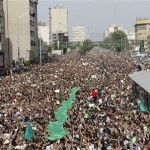
Since last year's disputed presidential election, which brought millions of protesters onto the streets, the authorities have intensified their long-standing suppression of both the traditional Iranian media and the rising number of "citizen journalists" who use new technology to expose human rights violations.
Iran has been described by press freedom organizations as the biggest jailer of journalists in the world.
Hassiba Hadj Sahraoui, Amnesty International's Deputy Director for the Middle East and North Africa said: "Since the protests, the government's growing bunker mentality has led to mounting waves of repression aimed at suppressing any criticism of the authorities or independent reporting on the human rights situation in the country.
"Dozens of newspapers and websites have been closed, and scores of journalists and bloggers have been arrested and are held as prisoners of conscience or have had to flee the country for their own safety.
"Contact with some foreign media has been criminalized and a new 'Cyber-Crimes Law' is already having major implications for freedom of expression. The authorities must urgently relax both the long standing and new sweeping restrictions and immediately release those held as prisoners of conscience."
The Association of Iranian Journalists was closed by the authorities in August 2009 and a number of its officials arrested, including Secretary Badrolsadat Mofidi who by April 2010 had spent four months in detention without charge or trial.
Blogging, once an effective way around Iran's draconian press censorship, is now a risky business. The once-thriving blogosphere is under fire, with those involved subjected to arbitrary arrest or harassment. Some have had to flee the country for their own safety.
Aida Saadat, a freelance journalist and human rights campaigner, active with the One Million Signature Campaign and the Committee of Human Rights Reporters was repeatedly interrogated; and beaten up while walking home. Fearing for her life, she eventually fled Iran.
She told Amnesty International: "I could not find any human rights or other organization to defend me, as a journalist. They had been silenced. The men who attacked me said 'this is just a warning. Next time we will kill you for your activities against the people of our country…' This is what we have been facing. I and so many others had to leave. Our lives were at stake."
Many of the detainees and those who fled worked for papers or online publications which supported or could have been perceived as supporting the defeated reformist candidates in the presidential elections, or are freelancers, some of whom who had lost jobs with previously-banned publications while others provided an independent voice, often about the human rights situation. At one point officials arrested the entire staff of Kalameh Sabz, a newspaper established by opposition candidate Mir Hossein Mousavi.
Prisoner of conscience Isa Saharkhiz, a prominent journalist working with reformist candidate Mehdi Karroubi, was arrested in July 2009 during the post election unrest; by April 2010 he had yet to be charged with any offence. His son, Mehdi, a US-based blogger, explains: "What happened is at one point they realized that the media is playing a big role at getting the news out and getting the truth out. So what they did was they arrested well known journalists, so other journalists who are working will learn from this… and they will write just what the state wants them to write."
Other targets included journalists writing on human rights issues, such as the internationally-acclaimed Emadeddin Baghi, founder of the Association for the Defence of Prisoners' Rights. Some journalists have been sentenced to lengthy prison terms after conviction in mass "show trials".
Detainees have faced human rights violations ranging from torture and other ill-treatment, including beatings, solitary confinement for lengthy periods, to grossly unfair trials. Many have been held incommunicado for weeks or months without charge or trial.
Some of those freed still remain under pressure, having had to give up the deeds to their - or their relatives' - houses to raise bail. Detainees' families have been harassed or temporarily detained; some have been warned their loved ones won't be freed if they speak to the media about their plight.
Criminalizing contacts with foreigners: The 'Velvet Coup'
With Iran's media limited in their reporting by government censorship and fearful of crossing the "red line" over the decades, many Iranians have in the past tuned in to foreign radio stations, or watched international TV networks via illegal, though previously largely tolerated, satellite dishes. Since the first election of President Ahmadinejad in 2005, Iranian security forces have conducted an increasing number of raids to seize such dishes.
The authorities have also reduced the number of foreign correspondents based in Iran; when political unrest erupted in mid-2009, those remaining were barred from covering mass opposition rallies.
International media broadcasting in Persian were singled out and their Iranian contributors targeted. The BBC's Tehran correspondent was expelled. Maziar Bahari, working for Newsweek, - one of two international journalists arrested at the time - was released only after making a dubious public "confession" following weeks of physical and psychological torture.
Prosecutors in mass "show trials" accused foreign broadcasters like the BBC and the Voice of America (VOA) of stage-managing the protests and planning a "soft coup". Some of the accused were charged with working with foreign channels in order to "incite and provoke public opinion".
In January, both the BBC and VOA were included on a list of "subversive" organizations which Iranians were banned from contacting. Both networks have had their satellite transmissions into Iran blocked but the truth is that now any contribution to any overseas Persian-language broadcaster is regarded as suspicious if not seditious.
From cassettes to Twitter
After decades of repression, Iranians are adept at finding a way around state censorship. In the 1970s, Ayatollah Khomeini, then an exiled opponent of the former Shah, used cassette tapes of his sermons smuggled in from abroad to denounce the Shah's increasingly autocratic rule. Those cassettes played an important part in the subsequent Islamic Revolution.
In 1999, the closure of Salam newspaper led to mass student-led protests - and eventually to violent confrontations between them and the security forces. Over the next few years, the media became a focal point in the power struggle between conservative and reformist factions.
More than a hundred newspapers and periodicals were closed. There was a explosion of internet use as Iranian writers increasingly turned to it as virtually the only remaining forum for free expression. Internet usage in Iran in recent years has grown faster than in any other Middle Eastern country.
But the authorities have been hot on the bloggers' heels, filtering and blocking access to many sites, ranging from those considered "immoral" or "anti-Islamic" to political websites or blogs critical of the government.
At one stage, an Iranian official claimed that five million sites were being blocked. Facebook and Twitter - used to spread information about last year's demonstrations - were briefly shut down and other internet sites such as social networking site Badoo have been banned.
Last February, the authorities announced that access to Google's email service was to be permanently blocked. Some tech savvy Iranians continue to find their way around the system, using filter-busting software, encryption services or "proxy" internet servers outside Iran, although they have been hampered by speed slowdowns, or even brief blockages of internet access.
The latest salvo in the battle came when the Cyber-Crimes Law came into effect in July 2009; human rights groups say it could help the authorities track down government critics. But images of the killing of Neda Agha Soltan during a demonstration in July 2009, captured by mobile phone camera and almost instantly distributed across the world, became the symbol of the futility of attempts by the authorities to conceal the truth and control new media and social networks.
It's all led to what Mehdi Saharkhiz describes as "a cat and mouse game," with Iranians trying to circumvent official filters as soon as they are set up. He also points to a huge rise in the number of "citizen journalists" many of whom have managed to send news or videos for posting on his US-based website.
During the 2009 protests, he says the amount of video material coming in was "staggering". Some contributors, he says, are professional journalists who now prefer to work anonymously in order to keep under the official radar. Others may be friends or neighbours of political prisoners, or just individuals who see something they want to share with others.
"Every person has become a media," he said. "Even taking pictures of this stuff is extremely dangerous for them. But they want to do this because they want to be heard. You can't control 70 million people."
URGENT ACTION: HUMAN RIGHTS ACTIVIST ARRESTED IN IRAN
AMNESTY INTERNATIONAL
18 March 2010
Navid Khanjani, a member of an Iranian human rights organization, the Committee of Human Rights Reporters (CHRR), was arrested on 2 March. Three other CHRR members are currently detained, and all are at risk of torture or other ill-treatment. Navid Khanjani was arrested at his home in the city of Esfahan, central Iran, at 11 pm by seven members of the security forces, who had a warrant for his arrest issued by the Revolutionary Court. The security guards searched his home, confiscated personal belongings, including his computer, and told him that he would be taken to Evin prison in Tehran the following day. Navid Khanjani made a phonecall on 4 March confirming he was in Evin prison. As well as belonging to CHRR, Navid Khanjani is the founder of the Oppose Discrimination in Education Association. An independent organization created around October 2009, it advocates education for all and opposes the denial of access to education for reasons of ethnic or religiousness identity. He is a member of the Baha'i community, which is an unrecognized religious group in Iran. He was banned from pursuing his university studies because of his Baha'i faith and has since spoken out for the right to education for all over the past few years. Three other CHRR members were released on bail this month after paying up to $100,000 each. Saeed Kalanaki was released on 2 March, Mehrdad Rahimi was released on 9 March and Saeed Jalifar was released on 16 March. There is still no further information about the three CHRR activists who are still in detention in Evin Prison, Shiva Nazar Ahari, Kouhyar Goudarzi and Saeed Haeri. None of them has had contact with a lawyer and all are at risk of torture and other ill-treatment PLEASE WRITE IMMEDIATELY in Persian, English, Arabic, French, or your own language: * Calling on the authorities to release CHRR members, Navid Khanjani, Shiva Nazar Ahari, Kouhyar Goudarzi and Saeed Haeri immediately and unconditionally, as they appear to be prisoners of conscience held solely for their peaceful human rights activities; * Urging them to ensure that they are protected from torture and other ill-treatment and granted immediate and regular access to lawyers of their choosing, their families and any medical treatment they may require; * Reminding the authorities that confessions extracted under duress are prohibited under Article 38 of the Constitution of Iran and by Article 14(g) of the International Covenant on Civil and Political Rights, to which Iran is a state party.
PLEASE SEND APPEALS BEFORE 28 APRIL 2010 TO:
Leader of the Islamic Republic Ayatollah Sayed 'Ali Khamenei The Office of the Supreme Leader Islamic Republic Street - End of Shahid Keshvar Doust Street, Tehran, Islamic Republic of Iran Email: info_leader@leader.ir via website: http://www.leader.ir/langs/en/index.php?p'letter (English) Salutation: Your Excellency
Head of the Judiciary in Tehran Ali Reza Avaei Karimkhan Zand Avenue Sana'i Avenue, Corner of Ally 17, No 152 Tehran, Islamic Republic of Iran Email: avaei@Dadgostary-tehran.ir Salutation: Dear Mr Avaei
And copies to: Secretary General, High Council for Human Rights Mohammad Javad Larijani Howzeh Riassat-e Ghoveh Ghazaiyeh Pasteur St, Vali Asr Ave., south of Serah-e Jomhuri Tehran 1316814737 Islamic Republic of Iran Fax: +98 21 3390 4986 Email: bia.judi@yahoo.com (In subject line: FAO Mohammad Javad Larijani) Salutation: Dear Mr Larijani Also send copies to diplomatic representatives accredited to your country. Please check with your section office if sending appeals after the above date. This is the third update of UA 347/09 (MDE 13/132/2009). For more information: http://www.amnesty.org/en/library/info/MDE13/132/2009/en, http://www.amnesty.org/en/library/info/MDE13/017/2010/en and http://www.amnesty.org/en/library/info/MDE13/023/2010/en
URGENT ACTION HUMAN RIGHTS ACTIVIST ARRESTED IN IRAN ADDITIONAL INFORMATION The CHRR was founded in 2006 and campaigns against all kinds of human rights violations, including against women, children, prisoners, workers and others. On or around 21 January, Abbas Ja'fari Dowlatabadi, the Tehran prosecutor told Shiva Nazar Ahari's family in a meeting that: "Experts of the case have reported that the website for the Committee is linked to 'hypocrites' (the Iranian authorities' name for the banned opposition group, the People's Mojahedin Organization of Iran, PMOI, which has a base in Iraq), and any collaboration with the Committee is considered a crime." Most of the members of the "Oppose Discrimination in Education Association" (Jami'iat-e Mobarzeh ba Taba'iz-e Tahsili) are said to be Baha'i students who have been deprived of education as a result of being expelled or suspended, usually from universities. The organisation campaigns for the right to education for those excluded for reason of religious or ethnic identity or on grounds of gender discrimination. On 11 February, Shiva Nazar Ahari told her family by phone that she had been transferred to a "cage-like" solitary confinement cell where she cannot move her arms or legs. Since her arrest on 20 December she has been held without charge or access to her lawyer. She added that she was still under pressure to accept "accusations," whose content she does not know. On 10 March 2010, an Iranian human rights activist, Shadi Sadr, was one of the ten awarded the United States-based International Women of Courage Award. In her acceptance speech, Shadi Sadr stated that she dedicated the award to CHRR member and founder, Shiva Nazar Ahari, stating that "her courage has been exceptional and deserving of worldwide attention." She added that "They [the Iranian authorities] kept her for a long period in a cage-like cell so small that she could barely move her limbs." (see: http://chrr.us/spip.php?article8819 ) Prior to their release, Saeed Kalanaki and Saeed Jalalifar were both arrested on 30 November 2009 and were held in a public section of Evin prison. Both men were forced to telephone two other CHRR members urging them to close the CHRR website. During the exchange, interrogators took the telephone away from them and threatened the other CHRR activists, telling them that if they did not stop posting information, they would be dealt with "either within prison or outside". Saeed Haeri, Kouhyar Goudarzi and Shiva Nazar Ahari were arrested on 20 December by police officers and officials from the Ministry of Intelligence in Tehran. They were taken from a bus which was about to drive to the northern city of Qom, where the funeral of Grand Ayatollah Montazeri took place on 21 December. They are held in Section 209 of Evin prison, which is under the control of the Ministry of Intelligence. Following the telephone threats the Ministry of Intelligence summoned four members of the CHRR to their offices in central Tehran on 1 January. Parisa Kakaei and Mehrdad Rahimi presented themselves and were immediately arrested. Mehrdad Rahimi is a student activist and deputy head of the Committee for Defence of the Rights of Citizens in the central office of Mehdi Karoubi. He phoned his family in February and said that he was being held in a small cell with six other prisoners. He said the cell was so small that they could not even sleep comfortably; his interrogation sessions had lasted several hours, in an attempt to force him to make televised confessions. Since the disputed presidential election in June 2009, thousands have been arrested, mostly arbitrarily and many have been tortured or otherwise ill-treated. Scores have faced unfair trial, including some in mass "show trials", with over 80 sentenced to prison terms, and at least 12 sentenced to death, although at least one has had his sentence commuted to a prison term. Waves of arrests, notably of political activists, students, journalists and human rights activists has been taking place since a Shi'a religious festival called 'Ashoura, on 27 December 2009 and Iran's national day on 11 February 2010. FU on UA: 347/09 Index: MDE 13/035/2010 Issue Date: 18 March 2010
Date: 18 March 2010
FU on UA: 347/09 Index: MDE 13/035/2010 Iran Date: 18 March 2010
AMNESTY INTERNATIONAL - URGENT ACTION: STUDENT ACTIVIST DETAINED without charge
AMNESTY INTERNATIONAL STUDENT ACTIVIST
DETAINED Without Charge
15 March 2010
Student leader Milad Asadi has been detained without charge in Evin
Prison, Tehran, since 1 December 2009. Amnesty International
believes he is a prisoner of conscience, held solely for the
peaceful exercise of his rights to freedom of expression,
association and assembly. He is at risk of torture or other
ill-treatment.
23-year-old Milad Asadiis a student of electrical
engineering at Khajeh Nasir University and is also a leading member
of the Office for the Consolidation of Unity (OCU), a national
student body which has been prominent in demanding political reform
and an end to human rights violations in recent years. He was
arrested shortly before mass demonstrations against the government
took place on university campuses on 7 December, which is Students'
Day in Iran, marking the anniversary of the killing of three
students in 1953 by police.
He told his family during a visit in mid-January that he had been
held for 46 days in solitary confinement in a tiny cell only two
metres wide and two metres long. According to the website Reporters
and Human Rights Activists in Iran, Milad Asadi told his family
during a prison visit in February that he would be tried on 3
March, but this is not known to have taken place.
At least three other prominent members of the OCU - Mehdi
Arabshahi, Behareh Hedayat and Amin Nazari are also detained.
Another - Morteza Samyari - has been released on bail after being
sentenced to six years in prison. He was convicted of vaguely
worded offences apparently related to his peaceful exercise of his
right to freedom of expression and association, following an unfair
trial.
PLEASE WRITE
IMMEDIATELY in Persian, Arabic, English, French or your own
language:
Calling on the Iranian authorities to immediately and
unconditionally release Milad Asadi and any other students held
solely for the peaceful exercise of their right to freedom of
expression and association;
Urging them to ensure that Milad Asadi is protected from torture
and other ill-treatment, and has access to a lawyer of his choice,
his family and any medical treatment he may require;
Reminding the Iranian authorities that freedom of expression,
association and assembly are guaranteed under the International
Covenant on Civil and Political Rights to which Iran is a state
party.
PLEASE SEND
APPEALS BEFORE 26 APRIL 2010 TO:
Leader of the Islamic
Republic
Ayatollah Sayed
'Ali Khamenei
The Office of
the Supreme Leader
Islamic Republic
Street - End of Shahid Keshvar Doust Street, Tehran, Islamic
Republic of Iran
Email:
info_leader@leader.ir
via
website: http://www.leader.ir/langs/en/index.php?p=letter
(English)
Salutation: Your
Excellency
Head of the Provincial Judiciary in
Tehran
Ali Reza Avaei
Karimkhan Zand
Avenue
Sana'i Avenue, Corner
of Alley 17, No. 152
Tehran, Islamic
Republic of Iran
Email: avaei@Dadgostary-tehran.ir
Salutation: Dear
Mr Avaei
And copies to:
Secretary General, High Council for
Human Rights
Mohammad Javad
Larijani
Howzeh Riassat-e
Ghoveh Ghazaiyeh
Pasteur St, Vali
Asr Ave., south of Serah-e Jomhuri
Tehran
1316814737
Islamic Republic
of Iran
Fax:
+98 21 3390 4986
Email:bia.judi@yahoo.com(In subject line: FAO Mohammad Javad
Larijani)
Salutation: Dear Mr Larijan
Also send
copies to diplomatic representatives accredited to your
country. Please check with your section office if sending
appeals after the above date.
URGENT ACTION
STUDENT ACTIVIST
DETAINED without charge
ADditional Information
Milad Asadi sits on the Central Committee of the OCU. At least
three other members of the Central Committee of the OCU are
currently in detention. They are Mehdi Arabshahi, who is the
Secretary of the OCU, arrested on 27 December 2009 - the religious
festival of Ashoura - when mass demonstrations against the
government took place; Behareh Hedayat, who is also the Chair of
the Women's Committee of the OCU, arrested on 31 December 2009, and
Amin Nazari, also chair of the OCU Human Rights Committee, arrested
on 27 February 2010. Another member, Morteza Samyari, was sentenced
to six years in prison on 18 February for "propaganda against the
system" and "gathering and colluding with the intent of harming
state security", but was subsequently released on bail pending an
appeal against his conviction and sentence.
Amnesty International has previously taken action on behalf of
Mehdi Arabshahi and Bahareh Hedayat during an earlier detention
(See Urgent Action, (Index: MDE 13/095/2007), 27 July 2007,
http://www.amnesty.org/en/library/info/MDE13/095/2007)
24-year-old Morteza Samyari, arrested on 4 January 2010, appeared
in a mass "show trial" of 16 persons on 30 January 2010. All were
accused of involvement in orchestrating the Ashoura protests. He
was sentenced on 18 February 2010 to one year in prison on the
charge of propaganda against the system and a five-year prison
sentence on the charge of "gathering and colluding with the intent
to act against national security", apparently in connection with a
proposed meeting with EU representatives which never took place. He
was released on bail of 500 million rials (approx US$500,000) and a
guarantee of a further 100 millions rials (approx US$100,000) on 7
March 2010, pending an appeal against his conviction and
sentence.
Since the disputed presidential election in June 2009, over 5,000
people have been arrested, including over 1,000 during and
following the mass demonstrations on Ashoura on 27 December. Those
detained include political figures and political activists,
students, human rights defenders and journalists. Many have been
tried in grossly unfair trials, resulting in long prison term
sentences and some sentences of flogging. At least 13 individuals
have been sentenced to death, of whom two have been executed and
three have had their sentences commuted to prison terms. Those
known to be on death row include Ahmad Karimi and Amir Reza Arefi,
convicted of "moharebeh" (enmity against God) for alleged
membership of the Anjoman-e Padashahi Iran, a group which advocates
the restoration of a monarchy in Iran, and five unnamed individuals
(two women and three men) said to have been tried and convicted in
January 2010 of "moharebeh" for alleged membership of the
People's Mojahedin Organization of Iran and organizing the Ashoura
demonstrations. 20-year old Damghan university student Mohammad
Amin Valian has also been sentenced to death, although his appeal
has not yet been heard. He was one of five people charged with
"moharebeh" during the trial of 16 in which Morteza Samyari
was also tried. Video footage of him throwing stones during the
Ashoura demonstrations was shown in court and was used as evidence
to convict him of "moharebeh".
"Moharebeh" is a vaguely worded criminal offence in Iranian
law, usually applied to those who take up arms against the state.
It can carry the death sentence.
The Iranian authorities are continuing to severely restrict freedom
of expression in Iran, arresting journalists and human rights
activists (of whom scores are believed to remain in detention),
imposing restrictions on the use of the internet, including social
networking sites, and shutting down newspapers. A renewed campaign
of arrests of human rights activists began in early March 2010 (see
UA 50/10, 12 March 2010,(Index: MDE 13/029/2010)).
For further information please see Iran: Election Contested,
Repression Compounded, December 2009, (Index MDE 13/123/2009).
UA: 62/10 Index: MDE 13/032/2010 Issue Date: 15 March 2010
Iran urged to release journalist jailed for political activism
AMNESTY INTERNATIONAL
4 March 2010
Amnesty International has called on the Iranian authorities to release a journalist and women's rights campaigner imprisoned for her political activism in the wake of last year's disputed presidential election.
Hengameh Shahidi began serving a six-year sentence at Tehran's Evin Prison last week, after an appeal court ruling upheld her conviction.
Her imprisonment is the latest in a series of ongoing attacks on journalists and media outlets close to the opposition.
Shortly after her arrest, the Press Supervisory Board on 1 March 2010 closed the E'temad daily newspaper, run by Elias Hazrati, a supporter of defeated presidential candidate Mehdi Karroubi, and the weekly journal Iran Dokht (run by Mehdi Karroubi's wife and son).
Sina, a weekly provincial newspaper, was also closed, for allegedly not operating in line with the constitution.
Hengameh Shahidi's sentence includes five years for "gathering and colluding with intent to harm state security" and one year for "propaganda against the system". The appeal court overturned another conviction for "insulting the president" which carried a sentence of 91 days and a fine.
Amnesty International said it considers Hengameh Shahidi to be a prisoner of conscience, held solely for peacefully exercising her rights to freedom of expression, association and assembly.
Hengameh Shahidi was an advisor on women's issues to defeated presidential candidate Mehdi Karroubi during his election campaign and is a member of his National Trust party.
Originally arrested on 30 June 2009, she was held at Evin Prison for over four months before she was released on bail on 1 November after she went on hunger strike in protest at her continued detention.
During her detention, Hengameh Shahidi says she was tortured and on several occasions she was threatened with execution. Once she said she was subjected to a mock execution. Her interrogators also threatened to arrest other family members.
At her trial on 4 November 2009, Hengameh Shahidi was accused of taking part in demonstrations against the disputed presidential election result between 13 and 17 June and giving an interview to the media and collecting signatures for the "One Million Signatures Campaign (also known as the Campaign for Equality - which aims to end discrimination against women in Iranian law).
She was also accused of supporting a campaign to end executions by stoning in Iran, signing numerous statements addressed to United Nations human rights bodies about human rights violations in Iran, and publishing articles on her blog.
Hengameh Shahidi was rearrested on 25 February 2010 and taken to Evin Prison, after being summoned to the Ministry of Intelligence investigations office "to answer a few questions". Two days later her lawyer, Mohammad Mostafaei, was shown the appeal court ruling upholding her prison sentence.
Amnesty International has urged the Iranian authorities to ensure that while imprisoned, she is granted access to her family, her lawyer and to all necessary medical treatment, including for her heart problems.
The organization also called for an immediate, thorough and impartial investigation into Hengameh Shahidi's allegations of torture in detention and for anyone found responsible to be brought to justice promptly and fairly.
Amnesty International also called for closed newspapers to be reopened and for all undue restrictions on the freedom of the press to be lifted.
Since the disputed presidential election in June 2009, the authorities have acknowledged over 5,000 people have been arrested, including over 1,000 during and following mass demonstrations on the religious festival of Ashoura on 27 December. The true number is likely to be higher.
Those detained include political figures and political activists, students, human rights defenders and journalists.
Many have been tried in grossly unfair trials, resulting in long prison term sentences and some sentences of flogging. At least 13 have been sentenced to death, of whom two have been executed and three have had their sentences commuted to prison terms.
The Iranian authorities are continuing to severely restrict freedom of expression in Iran, arresting journalists (of whom scores are believed to remain in detention), imposing restrictions on the use of the internet, including social networking sites, and shutting down newspapers.
Iran 'shows contempt' for human rights by rejecting UN recommendations
AMNESTY INTERNATIONAL - PRESS RELEASE
17 February 2010
Amnesty International today criticised Iran for rejecting important recommendations by the United Nations to improve human rights in the country.
The recommendations rejected by Iran include: ending the execution of juvenile offenders; upholding fair trial guarantees, investigating torture allegations, including rape and releasing people detained for peacefully exercising their human rights.
The Iran delegation also only paid lip service to cooperation with the Human Rights Council.
While accepting a recommendation to cooperate with UN's human rights experts, Iran rejected several others to allow the Council's Special Rapporteur on torture to visit the country.
The delegation accepted the recommendation to respect freedom of religion but rejected a recommendation to end discrimination against the Bahai's.
"By rejecting specific recommendations made by dozens of countries the Iranian authorities showed contempt for international obligations just as they have done in their treatment of their own people," said Hassiba Hadj Sahraoui, Middle East and North Africa Deputy Director at Amnesty International.
"By promising to consider recommendations to eliminate the execution of juvenile offenders, the Iranian authorities are cynically camouflaging their existing obligation under the Convention on the Rights of the Child not to execute juvenile offending," said Hassiba Hadj Sahraoui.
The UN's Human Rights Council in Geneva has been reviewing Iran's human rights record where the Iran delegation responded to a series of recommendations put to them by other UN member states.
The delegation accepted 123 recommendations, reserved its position on 20 other and rejected 45 recommendations.
Amnesty International is perplexed by the numerous contradictions between recommendations accepted and those rejected.
The cavalier rejection of some recommendations similar to others accepted cast doubt on the willingness of the authorities to implement the recommendations accepted.
Iran has said it is carrying out investigations into cases of torture and killing that occurred following the unrest that occurred following the presidential election in June 2009.
However, despite reports of parliamentary investigations, no one appears to have been brought to justice over the killing of Neda Agha Soltan, a peaceful demonstrator who was shot in a street in June 2009 or Mohsen Ruholamini who died in custody in July 2009.
On the other hand, it rejected recommendations on investigations of torture allegations and unlawful killings and thereby perpetuate a climate of impunity.
The country's authorities also said they would strengthen cooperation with human rights organizations, yet they have failed to respond to repeated requests by Amnesty International to meet with members of the Iranian delegation.
"For human rights to really improve in Iran, the authorities must end the double-speak and take concrete measures, like ending the execution of juvenile offenders; ensure fair trials; halt torture and end impunity for all violations."
URGENT ACTION - IRAN MUST RELEASE HUMAN RIGHTS DEFENDER
5 February 2010
5 February 2010
Human rights defender and journalist Kaveh Ghasemi Kermanshahi was
arrested in the west of Iran on 3 February by plainclothes
officials believed to be Revolutionary Guards. He is a prisoner of
conscience, held solely for his peaceful human rights activities.
His family has not been informed of his whereabouts and he is at
risk of torture or other ill-treatment.
Kaveh Ghasemi
Kermanshahi,aged 25, was arrested by
seven plainclothes officials at his home in the city of Kermanshah,
in western Iran. His home was searched and his personal belongings,
including his computer and documents related to his work, were
confiscated. The arresting officials presented him with a warrant
that did not specify which authority had issued it but accused him
of "propaganda against the state". His family has not been informed
of his whereabouts.
Kaveh Ghasemi Kermanshahi is a leading member of the Human
Rights Organization of Kurdistan (HROK, sometimes known as RMMK
from its Kurdish name), and a member of the women's rights group,
the Campaign for Equality, also known as the One Million
Signatures Campaign. He is also a journalist for
Iranian news website Rooz Online, and writes for the HROK and
Campaign for Equality websites. He is an
active campaigner against the death penalty. He reported on the
protests against the execution on 11 November 2009 of Ehsan
Fattahian, a member of Iran's Kurdish
minority (see UA: 271/09 Index: MDE 13/119/2009). He was the only journalist who reported on the
authorities' transfer of Ehsan Fattahian's body for burial in a
cemetery in Kermanshah, which took place without the knowledge of
Ehsan Fattahian's family.
PLEASE WRITE
IMMEDIATELY in Persian, Arabic, English, French or your own
language:
Calling on the Iranian authorities to release Kaveh Ghasemi Kermanshahi immediately and
unconditionally, as he is a prisoner of conscience, arrested solely
for his human rights activities and the peaceful exercise of his
right to freedom of expression and association;
Urging them to disclose his whereabouts immediately, and to ensure
that he is protected from torture and other ill-treatment, and has
access to a lawyer of his own choosing, his family and any medical
treatment he may require;
Reminding the authorities that, as a state party to the
International Covenant on Civil and Political Rights, Iran is
obliged to uphold the right to freedom of expression and
association.
PLEASE SEND
APPEALS BEFORE 19 MARCH 2010 TO:
Leader of the Islamic
Republic
Ayatollah Sayed
'Ali Khamenei
The Office of
the Supreme Leader
Islamic Republic
Street - End of Shahid Keshvar Doust Street, Tehran, Islamic
Republic of Iran
Email:
info_leader@leader.ir
via
website: http://www.leader.ir/langs/en/index.php?p=letter
(English)
Salutation:
Your Excellency
Head of the
Judiciary
Ayatollah Sadeqh
Larijani
Howzeh Riyasat-e
Qoveh Qazaiyeh (Office of the Head of the Judiciary)
Pasteur St.,
Vali Asr Ave., south of Serah-e Jomhouri, Tehran, 1316814737
First starred box:
your given name; second starred box: your family name; third: your
email address
Salutation: Your
Excellency
And copies to:
Director, Human Rights
Headquarters
Mohammad Javad
Larijani
Howzeh Riassat-e
Ghoveh Ghazaiyeh
Pasteur St, Vali
Asr Ave., south of Serah-e Jomhuri
Tehran
1316814737
Islamic Republic
of Iran
Fax:
+98 21 3390 4986
Email:bia.judi@yahoo.com(In subject line: FAO Mohammad Javad
Larijani)
Salutation: Dear Mr Larijani
Also send
copies to diplomatic representatives accredited to your
country. Please check with your section office if sending
appeals after the above date.
Amnesty International has urged the Iranian authorities not to execute nine people sentenced to death who were arrested in relation to the protests that followed last year's disputed presidential election.
The organization said it fears the Iranian authorities are planning to execute some or all of the nine in public before 11 February, the anniversary of the 1979 Islamic Revolution, when further protests are expected.
According to Iranian media reports, Deputy Judiciary Head Ebrahim Raisi said on Monday that, after the execution of two men last week, the nine others will be executed "soon".
"Those sentenced did not have had a fair trial," said Hassiba Hadj Sahraoui, Amnesty International's Middle East and North Africa Deputy Director. "They were denied access to a lawyer in the initial stages of their detention, and some or all appear to have been coerced into giving confessions.. It is also not clear whether those condemned have been able to exercise their right to appeal."
Iran's judiciary is reported to be under political pressure to execute more opposition supporters to end the continuing protests.
Mohammad Reza Ali-Zamani and Arash Rahmanipour were hanged in public last Thursday after being convicted in unfair trials of "enmity against God" and being members of Anjoman-e Padeshahi-e Iran (API), a banned group which advocates the restoration of an Iranian monarchy.
They were the first executions known to be related to the post-election violence that erupted across Iran in June and has continued since.
"Executing people in public further adds to the already cruel, inhuman and degrading nature of the death penalty," said Hassiba Hadj Sahraoui. "It can only have a dehumanizing effect on the person sentenced to death and a brutalizing effect on those who witness the execution, including the relatives."
Mohammad Reza Ali-Zamani and Arash Rahmanipour were convicted by Tehran's Revolutionary Court in October. Iran executed at least 14 people in public in 2009.
At least two of the nine others on death row, Naser Abdolhasani and Reza Kazemi, were sentenced to death in similar post-election "show trials". The identity of the other seven is unknown.
According to Iranian officials, over 40 people have died in demonstrations since the election, which were violently repressed by the security forces. Amnesty International believes the number to be much higher. More than 5,000 people have been arrested, many of whom were tortured or otherwise ill-treated.
Scores have been sentenced to prison terms, and in some cases flogging, after unfair trials, and at least 12 have been sentenced to death. One man – Hamed Rouhinejad - had his death sentence commuted to a 10-year prison term on appeal in January 2010.
Further information on UA: 341/09 Index: MDE 13/ /015/2010 Iran Date: 02 February 2010
Iranian student leader Majid Tavakkoli, held since 7 December 2009
after a demonstration, has been sentenced to eight years and six
months imprisonment after an unfair trial. He is believed to be
appealing against his conviction and sentence. He is a prisoner of
conscience, held solely for the peaceful exercise of his right to
freedom of expression, association and assembly.
Majid
Tavakkoli's trial before the Branch 15 of the Revolutionary
Court in Tehran began on 6 January 2010 and his lawyer was not
permitted to attend. He met his lawyer for the first time on 11
January. Majid Tavakkoli has only been allowed to contact his
family once by phone, after his trial concluded, when he told them
he was held in Evin Prison, Tehran. He has not been permitted any
family visits. He has been convicted of several offences, including
participating in an illegal gathering, propaganda against the
system and insulting officials. As well as receiving a prison
sentence, Majid Tavakkoli was banned for five years from political
activities and from leaving the country..
Majid
Tavakkoli was beaten as he was arrested leaving Amir Kabir
University of Technology in Tehran on 7 December. He had just given
a speech at a student demonstration marking Student Day in Iran,
held on the Persian date of 16 Azar, the anniversary of the killing
of three students by security forces in 1953. Dozens of students
and others were arrested around the time of the 7 December
protests, which took place in cities across the country. Many have
been released, but some remain in detention. The day after his
arrest, pictures of Majid Tavakkoli wearing women's clothing were
circulated, apparently intended to humiliate him.
PLEASE
WRITE IMMEDIATELY in Persian, Arabic, English, French or your own
language:
Calling on the Iranian authorities to immediately and
unconditionally release Majid Tavakkoli, and any others detained
around the 7 December demonstrations who are held solely for the
peaceful exercise of their rights to freedom of expression,
association and assembly;
Expressing concern that Majid Tavakkoli's trial was unfair as he
did not have access to a lawyer and urging that his appeal be heard
swiftly, with a view to facilitating his immediate release;
In the meantime, calling on the authorities to grant him immediate
and regular access to his family, his lawyer and any medical
treatment he may require;
Asking them to investigate promptly and impartially the reports
that Majid Tavakkoli was beaten during his arrest.
PLEASE SEND
APPEALS BEFORE 16 MARCH 2010 TO:
Head of the Provincial Judiciary in
Tehran
Ali Reza Avaei
Karimkhan Zand
Avenue
Sana'i Avenue, Corner
of Alley 17, No. 152
Tehran, Islamic
Republic of Iran
Email: avaei@Dadgostary-tehran.ir
Salutation: Dear
Mr Avaei
Head of the
Judiciary
Ayatollah Sadeqh
Larijani
Howzeh Riyasat-e
Qoveh Qazaiyeh (Office of the Head of the Judiciary)
Pasteur St.,
Vali Asr Ave., south of Serah-e Jomhouri, Tehran, 1316814737
Islamic Republic
of Iran
Email: Via
website: http://www.dadiran.ir/tabid/75/Default.aspxFirst starred
box: your given name; second starred box: your family name; third:
your email address
Salutation: Your
Excellency
And copies to:
Director, Human Rights
Headquarters
Mohammad Javad
Larijani
Howzeh Riassat-e
Ghoveh Ghazaiyeh
Pasteur St, Vali
Asr Ave., south of Serah-e Jomhuri
Tehran
1316814737
Islamic Republic
of Iran
Fax:
+98 21 3390 4986
Email:bia.judi@yahoo.com(In subject line: FAO Mohammad Javad
Larijani)
Salutation: Dear Mr Larijan
Also send
copies to diplomatic representatives accredited to your
country. Please check with your section office if sending
appeals after the above date. This is the first update to UA
341/09 (MDE 13/131/2009). Further information:
www.amnesty.org/en/library/info/MDE13/131/2009/en
URGENT ACTION
irANIAN STUDENT
LEADER sentenced
ADditional Information
Majid Tavakkoli, a
member of the Islamic Students' Association at Amir Kabir
University in Tehran, where he studied ship-building, was arrested
in May 2007 with three others, in connection with student
publications said to be insulting to Islam, which the students said
had been forged. He was tortured in detention and sentenced to
three years' imprisonment for "propaganda against the system" and
"insulting the Leader," reduced on appeal to 30 months. He was
released in August 2008 and allowed to resume his studies in
southern Iran.
He was arrested in
February 2009, with around 20 other students, after he took part in
a ceremony commemorating the life of the first prime minister to be
appointed after the February 1979 revolution, Mehdi Bazargan. Most
were soon released, but Majid Tavakkoli and three others were held
without trial until June 2009, when they were released on bail.
Majid Tavakkoli was the subjects of UA 113/07 and updates, and UA
70/09.
According to his
brother Ali in January 2010, Majid Tavakkoli has been sentenced to
five years for "participating in an illegal gathering"; one year
for "propaganda against the system"; two years for "insulting the
Supreme Leader"; six months for "insulting the President" and to
five-year ban on any involvement in political activities and on
leaving the country.
The day after his
arrest, Fars News Agency, which is close to the
Revolutionary Guards and the judiciary, published pictures of Majid
Tavakkoli wearing women's clothing, and said he had been wearing
them at the time of his arrest in order to escape detection.
Student websites and others, which have claimed that Majid
Tavakkoli was beaten at the time of his arrest, have denied that he
was wearing the clothes at the time, but suggested he was forced to
wear them afterwards to humiliate him.
After Majid Tavakkoli
was pictured wearing women's clothes, many Iranian men took
pictures of themselves with headcoverings, often holding signs
saying, "We are Majid" and posted them on the internet as part of a
solidarity campaign calling for his release. See for example
http://www.facebook.com/event.php?eid=198929939029#/photo_search.php?oid=198929939029&view=all
On 19 January, his
mother told Voice of America Persian service, a US
government-funded radio and television station in the USA which
broadcasts worldwide, "I am worn out after five years. His place is
not in prison. His problems should be solved in the university, not
in prison. He is entitled to the freedom of speech. For three
years, they have had us on a leash. We are constantly worried for
our son. He has done nothing, but studied hard. He had only made a
critical comment. He doesn't deserve prison. They said we are
entitled to freedom of speech. I am looking forward to seeing
Majid. I want to hear my son's voice when I see him. For a mother,
it is important to see her children. It is hard to wait for
children with tearful eyes and an aching heart."
Students have been at
the forefront of continuing protests at the disputed outcome of the
presidential election in June 2009 as well as at the widespread
human rights violations committed as the authorities banned
demonstrations and cracked down violently on protestors. Dozens of
people were killed by security forces using excessive force,
thousands were arrested, mostly arbitrarily and many were tortured
or otherwise ill-treated. Scores have faced unfair trial, including
some in mass show trials, with over 80 sentenced to prison terms,
and at least 12 sentenced to death, although at least one has been
commuted to a prison term. Two have so far been executed.
URGENT ACTION - THREE IRANIAN JOURNALISTS SENTENCED
AMNESTY INTERNATIONAL - PRESS RELEASE
Date 28 December 2009
Bahman
Ahmadi Amou'i and Saeed Laylaz have been sentenced to prison terms,
Bahman Ahmadi Amou'i also to flogging. Keyvan Samimi Behbehani
remains in solitary confinement. All three men are prisoners of
conscience.
Bahman Ahmadi Amou'i,aneditor at the business daily paper
Sarmayehwhich was closed by the authorities on 2
November,was sentenced to seven years and four
months' imprisonment and 32 lashes on 4 January 2010 by a
Revolutionary Court in Tehran. The sentence includes five years for
"colluding with intent to harm national security;" one year for
"propaganda against the system;" one year and 32 lashes for
"disrupting public security" and four months for "insulting the
president." His lawyer is lodging an appeal within the required 20
days and will request his release on bail until the appeal is
heard. He is held in Section 350 of Evin Prison. .
Saeed Laylaz, also an
editor at Sarmayeh,was sentenced to nine
years' imprisonment by a Revolutionary Court in Tehran on 2
December 2009 after he was convicted of "attending illegal
gatherings" and "possessing classified documents." His lawyer has
said that that his client had access to information that had been
posted online and therefore not classified information. Saeed
Laylaz has been refused bail and remains held in Evin Prison.
The editor of the
banned magazineNameh,Keyvan Samimi Behbehani, was
granted 10 days' leave from prison on 9 December in order to attend
his daughter's wedding. He has since returned to Evin Prison where
he is held in solitary confinement in Section 209.
PLEASE WRITE
IMMEDIATELY in Persian, Arabic, English, French or your own
language:
Calling on the authorities to release Bahman Ahmadi Amou'i, Saeed
Laylaz and Keyvan Samimi Behbehani immediately and unconditionally,
as they are being detained solely for their peaceful exercise of
the right to freedom of expression;
Expressing concern that Bahman Ahmadi Amou'i has been sentenced to
flogging, a cruel punishment which amounts to torture, and noting
that Iran is a state party to the International Covenant on Civil
and Political Rights (ICCPR) which strictly prohibits torture;
Urging the authorities to ensure they are not tortured or otherwise
ill-treated, and that reports of torture or other ill-treatment are
thoroughly investigated and anyone found responsible is brought to
justice in fair proceedings.
PLEASE SEND
APPEALS BEFORE 19 FEBRUARY 2010 TO:
Leader of the Islamic
Republic
Ayatollah Sayed
'Ali Khamenei
The Office of
the Supreme Leader
Islamic Republic
Street - End of Shahid Keshvar Doust Street, Tehran, Islamic
Republic of Iran
Email:
via website: http://www.leader.ir/langs/en/index.php?p=letter
(English)
Bureau of
International Affairs, Office of the Head of the Judiciary, Pasteur
St., Vali Asr Ave. south of Serah-e Jomhouri, Tehran 1316814737,
Islamic Republic of Iran
Bahman Ahmadi Amou'i,
husband of journalist Zhila Bani Ya'qoub (who was released on 19
August) has been held at Evin Prison since his arrest on 20 June
2009. After 65 days of solitary confinement Bahman Ahmadi Amou'i
was moved in late August to a cell in Section 209 of the prison,
measuring 3.5 m˛ which he shared with two other detainees. Branch 2
of the Revolutionary Court acknowledged that they were
investigating him at the beginning of October but as the
investigation was still incomplete they would not allow his lawyer
to see the investigation file.
Saeed Laylaz had
appeared before Branch 28 of the Revolutionary Court in Tehran on
23 September to appeal against a two-month extension of his
detention order but his appeal was rejected, despite an earlier
order setting bail at two billion rials (approximately US$
200,000).
Following the Ashoura
commemoration on 27 December, which also coincided with the
seventh-day of mourning for Grand Ayatollah Montazeri, a senior
dissident cleric who had died the week before, well over a thousand
people are reported to have been arrested, including 500 in Tehran,
200 in Najafabad and 600 in Esfahan. They include at least fifteen
journalists: Mashallah Shamsolvaezin, Morteza Kazemian, Keyvan
Mehregan, Reza Tajik, Mostafa Izadi, Mohammad Javad Saber, Behrang
Tonkabani, Arvin Sedagatkish, Roozbeh Karimi, Mohammadreza Zohdi,
Ali Hekmat, Sam Mahmoudi and three women, Badrolsadat Mofidi, Negin
Derakhshan and Nasrin Vaziri.
Scores of people associated
with opposition parties, human rights defenders and students are
among many others detained since the demonstrations. The unrest on
'Ashoura was one of the worst since the days following the June
2009 presidential election. The authorities have stated variously
that between seven and fifteen people died, although have disputed
that security forces were responsible for all the deaths.
'Ashoura, the 10th day of the Islamic month of Moharram, is a Shi'a
Muslim religious occasion marking the killing, or martyrdom, of
Emam Hossein, the grandson of the Prophet Mohammad.
Since the
announcement that incumbent President Mahmoud Ahmadinejad had won
the 12 June election, which many people disputed, the authorities
have used excessive force to quell largely peaceful protests.
Before the recent demonstrations, the authorities acknowledged 36
deaths, while the opposition claims that over 70 have died. The
authorities have acknowledged that over 4,000 were arrested,
although the true figure may well be higher. Many of those detained
were tortured or otherwise ill-treated in detention centres across
the country. Some have alleged they were raped, although the
authorities have denied this after cursory investigations and other
measures which appear designed to hide, rather than uncover, the
truth. Over 80 have been sentenced to prison terms or flogging in
connection with the unrest, including those sentenced after mass
"show trials" which began in August. At least seven have been
sentenced to death - most recently Ahmad Karimi and Ali Zahed were
sentenced to death at the end of December 2009.
For further
information about the post-election events please see Iran:
Election contested, Repression compounded (Index MDE 13/123/2009),
December 2009,
http://www.amnesty.org/en/library/info/MDE13/123/2009/en
Further information on UA: 171/09 Index: MDE 13/002/2010 Issue
Date: 08 January 2010
AMNESTY INTERNATIONAL - PRESS RELEASE
Date 8 Jan 2010
Amnesty International today condemned the further and wholly avoidable loss of up to 8-15 lives in Iran during the 'Ashoura religious commemorations.
The organization called on the authorities to ensure that those attending funerals and commemorations in the coming days and weeks are guaranteed the right to assemble peacefully and to express their opposition to the current government.
"The spiral of violence is growing in Iran and the excessive force by the security forces appears to be meeting unprecedented resistance from protestors," said Hassiba Hadj Sahraoui, Amnesty International Deputy Director for the Middle East and North Africa.
Demonstrations on 27 December were policed by the Basij, a plain-clothed, volunteer paramilitary force under the control of the Revolutionary Guards, and the Special Forces units of the police. In the unrest following June's presidential elections, Basij personnel used firearms.
"The loss of life during 'Ashoura was wholly avoidable and this slide to more bloodshed must end now," said Hassiba Hadj Sahraoui.
Amnesty International has only been able to contact people in central Tehran who spoke of day-long clashes, from Vali Asr Square, College and Hafez Bridges - the latter of which security personnel used to hurl rocks at vehicles below - and Revolution Square (Meydan-e Enghlab) in the day to Mir-Damad street late into the evening as swathes of the city with covered in the smoke from the tear gas.
The funeral of 35 year old Seyed Ali Mousavi, the nephew of former presidential candidate and political leader, Mir Hossein Mousavi, is expected to take place along with others in the coming days.
Iran is bound by international human rights treaties such as the International Covenant on Civil and Political Rights that guarantee the right of peaceful assembly and expression.
"Despite Amnesty International's and others' advance appeals, in far too many places the authorities singularly failed to respect the rights of those Iranians taking part in 'Ashoura commemorations to peacefully assemble and to express themselves, even in opposition to the government. We deplore the increased levels of violence and renewed killing on 'Ashoura that was wholly avoidable."
"The Supreme Leader and government must instruct the police to end the use of force while leaders of the Revolutionary Guard must withdraw the Basij from demonstrations since time and time again it has been shown that their actions are fuelling conflict, leading to the loss of life."
Amnesty International again urged the authorities to invite to Iran independent human rights experts, such as those from the UN, in order to make an independent investigation into ongoing human rights violations.
"Inquiries announced by the authorities so far have been confusing and opaque and are simply not believed by most Iranians," Hassiba Hadj Sahraoui said.
Amnesty International also expressed concern at reports of arrests - possibly arbitrary - that are said to have taken place on 28 December. Reports indicate that political leader Ebrahim Yazdi had once again been detained along with three advisors to Mir Hossein Mousavi and Ayatollah Mousavi Tabrizi, a religious leader.
Human rights activist Emadeddin Baghi was detained at 06:45 in the morning, reportedly by four plain-clothed and armed men who are said to have forcibly entered Baghi's residence. A Dubai TV correspondent, a Syrian national, appeared to be unaccounted for in the course of 27 December
Background:
The unrest on 'Ashoura was the worst since the days following the June 2009 presidential election. As then, the mobile phone networks and internet services appeared largely disabled.
'Ashoura, the 10th day of the Islamic month of Moharram, is a Shi'a Muslim religious occasion marking the killing, or martyrdom, of Hossein, the grandson of the Prophet Mohammad and an important religious and community leader.
By around 21:00 GMT on 27 December the Acting Head of the Law Enforcement Forces (LEF) for Greater Tehran, Ahmad Reza Radan had admitted to four deaths in Tehran, adding that there were 300 arrests.
One person was said to have fallen off a bridge; two in car accidents and only one man - whose identity was not revealed - was said to have been shot. It is widely believed that this was a reference to Mir Hossein Mousavi's nephew.
Commander Ahmad Reza Radan of the Iranian police called the shooting suspicious since the police were not equipped with guns. During the unrest in June and July 2009, it appeared that only the Basij militia and members of the Revolutionary Guards were armed.
The authorities have claimed that some of those arrested belonged the illegal People's Mojahedin Organization of Iran (PMOI), banned since the early 1980s.
The Jonbesh-e Rah-e Sabz (JARAS) news outlet issued five names of individuals who were said to have been killed on 'Ashoura: Mehdi Farhadinia, Mohammad Ali Rasekhinia, Amir Arshadi, Shahram Faraji and Seyed Ali Mousavi, who is said to be the nephew of Mir Hossein Mousavi, one of the presidential candidates in June's election. Amnesty International has not been able to confirm the names issued.
Confrontation between thousands of mourners marking what is believed by Shi'a Muslims to be the martyrdom of Emam Hossein on the tenth ('ashoura) day of the month of Moharram and security officials were reported from Tabriz, Babol and Mashhad in the north of Iran; Tehran, Qom, Najaf Abad and Esfahan in the centre and Shiraz in the south.
Notes to editors
Amnesty International spokespeople are available. To request an interview or for more information please call +44 7778 472 126
Public Document
International Secretariat, Amnesty International, 1 Easton St., London WC1X 0DW, UK www.amnesty.org
Iran: Joint statement by Shirin Ebadi and Irene Khan
AMNESTY INTERNATIONAL
For release on Tuesday, 28 July 2009
The human rights crisis in Iran is deepening daily and next week's expected inauguration of Mahmoud Ahmadinejad for a second term as president may spark further protests and a massive new clampdown, warned Irene Khan, Amnesty International's Secretary General, and Iranian Nobel Peace Prize Laureate Shirin Ebadi today.
"Three days ago, thousands of people in over 100 cities across the world joined in a Global Day of Action in protest at the numerous arrests, beatings and killings that have accompanied the Iranian authorities' attempt to force through the declared election result, which is so widely disputed," said Irene Khan. "The purpose was to express our solidarity with those whose rights are being violated in Iran, and to send a message to Iran's Supreme Leader and those about him that the violations must cease. The world is watching."
Shirin Ebadi, Iran's most distinguished lawyer and human rights defender, is in London at Amnesty International's invitation.
An organization that she founded in 2001, the Centre for Human Rights Defenders (CHRD), was summarily shut down by the Iranian authorities last December because of its efforts to promote human rights and defend people who were detained and tortured. At least three of its leading members - journalist Abdolreza Tajik as well as Abdolfattah Soltani and Mohammad Ali Dadkhah, both leading human rights lawyers - have been detained since the start of the election-related protests. Two of them are held in Tehran's notorious Evin Prison, but the whereabouts of Mohammad Ali Dadkhah is unknown, raising particular fears for his safety.
"My colleagues have been rounded up because of their work to promote justice and the rule of law, and to defend the human rights of people in Iran," said Shirin Ebadi, who was awarded the Nobel Peace Prize in 2003. "They are now languishing in jail like so many others in my country because they stand up for universal values - the rights to freedom of opinion and expression and to register one's protest peacefully without fear of arrest or attack by strong-arm forces like the Basij."
Irene Khan and Shirin Ebadi cautioned that international attention and efforts must not fade, however intransigent the authorities in Tehran appear.
"People in Iran need international support now more than ever as the political divisions in Tehran play themselves out," said Shirin Ebadi. "International attention and pressure must be sustained and intensified if it is to have impact on those calling the shots in Tehran."
"In particular, the UN needs to play a more determined and decisive role," said Irene Khan. "Through its human rights and other mechanisms, the UN must investigate the violations taking place in Iran and compile evidence that can be used, one day, to bring those responsible to account."
Shirin Ebadi is visiting London as part of international efforts to highlight human rights abuses in Iran and to support a worldwide action that Amnesty International is launching in defence of the CHRD and its members, and to demand that it be allowed to reopen and continue its work.
Amnesty International
is concerned about further arrests of politicians, journalists,
lawyers and others in connection with the recent disputed
presidential election in Iran. Hundreds of people are believed to
be detained - many held in undisclosed locations - across Iran.
Scores more - possibly as many as 197 - are reported to have been
arrested on 9 July 2009 at a demonstration marking the tenth
anniversary of 18 Tir, the suppression of student-led protests in
1999 in which at least one student was killed and many others were
tortured or otherwise ill-treated. The families of those detained
for commemorating the victims of the 1999 crackdown are said to
have learnt only from posters pasted up by the authorities in
public places that they can find out about the detainees' cases at
court on 19 July 2009. Those detained are believed to be held in
Evin Prison and at a detention facility in Kahrizak in Karaj, near
Tehran.
Amnesty International
is calling for anyone held solely for peacefully exercising their
rights to freedom of expression, assembly and association to be
released immediately and unconditionally, and for all others to be
promptly charged and tried in proceedings which meet international
standards for fair trial or released. In any event, the authorities
should immediately clarify the fate of all those detained in
connection with recent events.
Amnesty International
is also calling for a full and impartial investigation into the
death of Sohrab Arabi, a 19-year-old student, who died from a
bullet wound to the heart. He disappeared during a demonstration on
15 June 2009. His family was then unable to find out any
information about him until 11 July when they were summoned to
court where they recognized him from photographs of dead
individuals. His body had apparently been at the Coroner's Office
since 19 June. There is, as yet, no information as to what happened
to him between 15 and 19 June, including either the exact date, or
the circumstances, of his death.
Among those reported
to have been arrested in recent days are political activists,
journalists, academics and lawyers. Amnesty International fears for
their safety in detention, as torture or other ill-treatment of
detainees is common in Iran. They include:
Journalist Massoud
Bastani, who was arrested on 5 July when he went to the
Revolutionary Court in Tehran to enquire about his pregnant wife
Mahsa Amr-Abadi, also a journalist, who was arrested on 14
June.
Human rights lawyer
Mohammad Ali Dadkhah, who was arrested on 8 July 2009 and taken
from his office in Tehran, along with several colleagues. Some of
his colleagues were released shortly afterwards, but Mohammad Ali
Dadkhah's whereabouts remain unknown.
Bijan Khajehpour
Khoei, a business and economic consultant, who was arrested on 27
June 2009 at Tehran airport when he arrived back from a trip to
Vienna and London. During his brief trip abroad, he spoke to trade
officials in Vienna and met the Iran British Business Chamber in
London as part of his work to support Iranian business and
encourage foreign investment in Iran. His whereabouts are unknown,
and his family fear for his health as he is diabetic.
Feyzollah Arabsorkhi,
a former deputy trade minister and a senior member of the Islamic
Revolution Mujahidin Organisation, a reformist political party, was
arrested on 7 July.
Journalist Kaveh
Mozaffari, who was only released from Evin Prison on 15 June
following his arrest on 1 May 2009 while covering a peaceful
demonstration by labour activists on International Labour Day, was
arrested in the street on 9 July by security forces.
Mohammad Reza
Yazdanpanah, a member of the Islamic Participation Front, was
arrested in Tehran on 7 July.
Joint US-Iranian
national Kian Tajbaksh, a social scientist and urban planner who
has taught at universities in Iran and the USA, was arrested at
9:00pm on 9 July 2009, at his home in Tehran. Two people who
identified themselves as Iranian security officials, arrived at his
residence, questioned him and his wife and searched the residence
for three hours, before taking him away along with two computers
and other items.
Mehdi Mahdavi Azad,
the director of the Shahab News site, was arrested on or around 23
June, but news of his arrest has only just been released.
Towhid Beigi, a
photographer associated with the campaign of presidential candidate
Mehdi Karroubi, was arrested in Enqelab Square, Tehran, during the
demonstrations of 9 July.
Journalist Hengameh
Shahidi, a member of the National Trust Party's Tehran branch, is
reported to have been arrested on 30 June.
Majid Sa'idi, a
well-known photographer for domestic and international media, was
arrested on 10 July from his home.
Background
information
In the month since
the announcement on 13 June that the incumbent President
Ahmadinejad had won the previous day's presidential election, which
hundreds of thousands of Iranians dispute, the Iranian authorities
have imposed draconian restrictions on freedom of expression,
association and assembly. Security forces, including the
paramilitary Basij, have been widely deployed in the streets to
prevent and disperse peaceful and other demonstrations.
Communications have been significantly disrupted and Iranian
publications have been banned from publishing information about the
nationwide unrest since the result was declared. Foreign
journalists have been banned from the streets, their visas not
renewed and some foreign reporters have been arrested or expelled
from the country.
According to
statements by officials recorded by Amnesty International, over
2,000 people have been arrested since 12 June by the police and
Basij forces across the country during demonstrations or in their
aftermath. These include prominent political figures close to two
of the presidential candidates, Mir Hossein Mousavi and Mehdi
Karroubi, and to former President Khatami, who supported Mir
Hossein Mousavi's presidential election campaign. Some human rights
defenders, as well as journalists have also been detained.
The authorities have
acknowledged that up to 21 people were killed during
demonstrations, but in at least some cases - such as that of Neda
Agha-Soltan - whose death was filmed and circulated widely on the
internet - they have denied that state officials were responsible,
although her death does not appear to have been properly
investigated. Unofficial Iranian sources say that many more
protestors were killed, but it remains difficult to obtain accurate
information about the total number of deaths as the whereabouts of
many demonstrators remain unknown and the authorities have placed
restrictions on bereaved families from holding memorial services.
In the past, according to information received by Amnesty
International, the Iranian authorities have under-reported deaths
at the hands of security forces during demonstrations.
Women's rights activist and lawyer violently arrested
NEWS FLASH AMNESTY INTERNATIONAL
17 July 2009
Amnesty International fears the wave of arrests of civil society activists in Iran is intensifying after lawyer and human rights activist, Shadi Sadr, was violently arrested in Tehran this morning on her way to Friday prayers.
Shadi Sadr was walking with a group of women's rights activists along a busy road when unidentified plain clothed men pulled her into a car. She lost her headscarf and coat in the ensuing struggle but managed briefly to escape. She was quickly recaptured and beaten with batons before being taken away in the car to an unknown location.
"This was an illegal, arbitrary and violent arrest in which no attempt was made by the authorities to show identification or provide any explanation for their action," said Malcolm Smart, Director of Amnesty International's Middle East and North Africa Programme."
"This is the latest of a continuing series of high profile arrests of Iranians - students, journalists, intellectuals, political and civil society activists - in the wake of protests over the disputed outcome of the presidential election."
Amnesty International is calling for Shadi Sadr to be immediately and unconditionally released.
Shadi Sadr is the defence lawyer of Shiva Nazar Ahari, a human rights defender and member of the Committee of Human Rights Reporters, who was arrested at her home in Tehran on 14 June 2009, shortly after the presidential election, by security officials who searched her house and took away personal items. She is now believed to be held in Section 209 of Tehran's Evin Prison where Shadi Sadr, her lawyer, had not been able to gain access to her.
Background
Shadi Sadr, lawyer and journalist, was the director of Raahi, a legal advice centrefor women until it was closed down. She founded Zanan-e Iran (Women of Iran), the first website dedicated to the work of Iranian women's rights activists (http://www.raahi.org) and has written extensively about Iranian women and their legal rights. She has represented activists and journalists, several women sentenced to execution, whose convictions were subsequently overturned. She is also involved in Women's Field (http://www.meydaan.com), a group of women's rights activists who have launched several campaigns to defend women's rights, including the "Stop Stoning Forever" Campaign.
Shadi Sadr was among 33 women arrested in March 2007. Most had gathered outside a Tehran courtroom to protest peacefully against the trial of five women - Fariba Davoudi Mohajer, Shahla
Entesari, Noushin Ahmadi Khorassani, Parvin Ardalan and Sussan Tahmasebi - who were accused of "propaganda against the system", "acting against national security" and "participating in an illegal demonstration" in connection with the 12 June 2006 demonstration. Four of those on trial were also among those arrested, along with Shadi Sadr, a lawyer. Initially held in the Vozara detention centre, some were later transferred to Evin Prison. Most were released after several days, but Shadi Sadr and Mahboubeh Abbasgholizadeh - who is also involved in the "Stop Stoning Forever" Campaign - were held for over two weeks before being released on bail.
At a Revolutionary Court session in August 2007, which their lawyer was not allowed to attend and during which they were also questioned about their NGOs and their activities in the "Stop Stoning Forever"campaign, they were charged with illegal assembly, collusion against national security, disruption of public order and refusal to obey the orders of the police
At least eight political leaders
remain in the custody of the Iranian Authorities, two of whom are
being supervised in hospital. Ebrahim Yazdi has been released. They
are all prisoners of conscience held solely on account of the
peaceful expression of their views, including regarding the outcome
of the election.
Seven of the eight political
leaders arrested in Tehran on 16 June 2009, in connection with
their perceived views on Iran's disputed presidential election or
their links with former president, Mohammad Khatami remain
detained. In addition to the individuals featured in the UA Mohsen
Mirdamadi, a former senior member of parliament and of the Islamic
Iran Participation Front (Jebhe-ye Mosharekat-e Iran-e Eslami) was
also arrested on 13 June. Ebrahim Yazdi was released on 19 June,
and was returned to a hospital in Tehran from where he had been
arrested whilst undergoing tests.
Former Tehran city counsellor,
advisor to former president Mohammad Khatami and investigative
journalist, Said Hajjarian was transferred from Evin Prison to
hospital under the control of the security forces, possibly on 3
July. Said Hajjarian is confined to a wheelchair following an
attempted assassination in 2000. His wife was able to visit him
once in prison. During her visit, Said Hajjarian told her that he
had been given the medication that she had delivered to the prison
two days after his arrest. On the day of the visit his blood
pressure was high, for which he received no treatment, he was also
in a poor psychological state. He requires, on a daily basis,
specialized medicines and physiotherapy, which appears to have been
denied. Mohsen Aminzadeh was also transferred to a hospital in
Tehran on 4 July, for reasons unknown to Amnesty International.
Both men remain incustody.
On 4 July, the lawyer representing Mohammad Ali Abtahi, Mohsen
Aminzadeh, Behzad Nabavi, Abdollah Ramazanzadeh, Mostafa Tajzadeh
and Mohsen Mirdamadi, said that he had not been allowed to visit
any of his clients and stated that "their general charge is acting
against national security" and that their cases would be referred
to revolutionary courts after preliminary investigation if they are
charged. None of their families have been allowed to meet them.
PLEASE WRITE
IMMEDIATELY in Persian, Arabic, English, French or your own
language:
calling on the
authorities to immediately and unconditionally release the
political leaders and activists (please name them) and all others
arrested solely on account of their peaceful views, including about
the outcome of the elections, as they are prisoners of
conscience;
urging the
authorities to ensure they are allowed immediate access to their
family members, lawyers of their choice and any medical treatment
they may require, and that they are not subjected to torture or
other ill-treatment;
urging the authorities to release them unless
they are charged with internationally recognizable criminal
offences in proceedings that meet internationally recognised fair
trial standards.
PLEASE SEND APPEALS BEFORE 19 August
2009:
Leader of the Islamic Republic
Ayatollah Sayed 'Ali Khamenei
The Office of the Supreme Leader
Islamic Republic Street - End of
Shahid Keshvar Doust Street, Tehran, Islamic Republic of Iran
Email: info_leader@leader.ir via
website: www.leader.ir/langs/en/index.php?p=letter (English)
Also send copies
to diplomatic representatives accredited to your country.
Please check with your section office if sending appeals after
the above date.
URGENT ACTION
POLITICAL PRISONERS REMAIN IN DETENTION
ADditional Information
In the days following the
announcement on 13 June that President Ahmadinejad had won the
previous day's presidential election, which hundreds of thousands
of Iranians dispute, the Iranian authorities have imposed draconian
restrictions on freedom of expression, association and assembly.
Security forces, including the paramilitary Basij have been widely
deployed in the streets; access to the internet and mobile phone
use have been intermittently blocked or significantly interrupted.
Iranian publications have been banned from publishing information
about the nationwide unrest since the result was declared. Foreign
journalists have been banned from the streets, their visas not
renewed and some foreign reporters have been arrested or expelled
from the country.
According to statements by
officials recorded by Amnesty International, at least 2277 people
have been arrested since 12 June by the police and Basij forces
across the country during demonstrations or their aftermath. These
include prominent political figures close to either Mir Hossein
Mousavi, fellow presidential candidate Mehdi Karroubi or former
President Khatami, who supported Mir Hossein Mousavi's campaign.
Some human rights defenders, as well as journalists have also been
detained. On 16 June lawyer and human rights defender Abdolfattah
Soltani, was also arrested and detained (please see UA 160/09, MDE
13/059/2009, 19 June 2009: http://www.amnesty.org/en/library/info/MDE13/059/2009/en).
Journalist Issa Saharkhiz was arrested on 4 July and taken away to
an undisclosed location (please see UA 181/09, MDE 13/067/2009, 6
July 2009: http://www.amnesty.org/en/library/info/MDE13/067/2009/en)
On 24 June, 70 academics met leading opposition candidate Mir
Hossein Mousavi, and were arrested as they left his office. All but
four were later released. Those still detained include the head of
Mir Hossein Mousavi's election campaign, Dr Ghorban Behzadian and
Ardeshir Amir Arjomand who is a professor of law at Shahid Beheshti
University. Hundreds of others have been arrested during
demonstrations against the outcome of the election which have been
met with excessive use of force. Officials acknowledge at least 21
killed although the true number is likely to be higher.
In custody Mohammad Ali Abtahi, Mohsen Aminzadeh, Behzad Nabavi,
Abdollah Ramazanzadeh, Mostafa Tajzadeh and Mohsen Mirdamadi,
Mohammad Tavassoli, Said Hajjarian.
Amnesty International urged the Iranian government to halt the public executions, scheduled for Tuesday 14 July, of 14 alleged members of the PRMI (People's Resistance Movement of Iran), also known as Jondallah, a Baluchi armed opposition group.
"The 14 did not receive a fair trial and these executions must not go ahead," said Malcolm Smart, Director of Amnesty International Middle East and North Africa Programme. "The Iranian authorities must abide by their international obligations to uphold human rights and guarantee fair trials, which is all the more essential in death penalty cases."
The 14, who include Abdolhamid Rigi, a brother of Jondallah's leader, are due to be hanged in public tomorrow morning in the city of Zahedan, south-east Iran. They were sentenced for moharebeh - "enmity against God" - for allegedly participating in armed attacks on officials and civilians and other offences. Abdolhamid Rigi's "confession" was recently broadcast on television even before he was tried, after he was forcibly returned to Iran from Pakistan in mid-2008.
Jondallah has carried out a number of attacks on Iranian government forces in Sistan-Baluchistan province, killing officials who were taken prisoner. Recently, Jondallah claimed responsibility for a suicide bomb attack on a mosque in Zahedan which killed as many as 25 worshippers. Amnesty International has repeatedly condemned such abuses. Most or all of those due to be executed tomorrow are believed to have been arrested before the attack on the mosque.
Iran: Journalists detained as news restrictions tighten
AMNESTY INTERNATIONAL
PRESS RELEASE
26 June 2009
The Iranian authorities must immediately release dozens of journalists arrested since 12 June and who are at risk of torture in detention, Amnesty International said today as it adopted all of them as prisoners of conscience.
'It is shocking that journalists - whose job it is to provide information to others - are being detained, on top of all the other draconian measures the authorities have taken to restrict the free flow of information about what is really happening in Iran. Rather than trying to investigate alleged abuses, the only message the authorities are sending is that they are seeking to hide the truth, both from their own citizens and the rest of the world.'
Dozens of journalists - some who also campaigned for either Mir Hossein Mousavi or Mehdi Karroubi, both candidates in the presidential election, have been detained in the past fortnight with their whereabouts mostly unknown.
For example, around 20 of 25 employees of the newspaper Kalameh Sabz arrested at their office in Haft Tir Square on 22 June are still detained and their whereabouts remain unknown. Kalameh Sabz is a newspaper established by presidential candidate Mir Hossein Mousavi in 2009, and which has not been published since 14 June.
Since the announcement on 13 June that President Ahmadinejad had won the election, the Iranian authorities have imposed severe restrictions on freedom of expression. Access to the internet has been blocked or significantly interrupted. Iranian publications have been banned from publishing information about the unrest. Foreign news journalists have been banned from the streets, and some foreign reporters have been expelled from the country.
'If nothing else, the authorities must immediately disclose the whereabouts of these journalists, ensure that they are not tortured or otherwise ill-treated and allow their families and lawyers access to them,' said Hassiba Hadj Sahraoui. 'Unless the authorities lift all unlawful restrictions on freedom of expression - which includes the right of journalists to report on events - and release all the journalists arrested, we can only assume they are trying to hide evidence of abuse and further silence any critical voice'.
Background:
Hundreds of politicians, journalists, academics, students and human rights defenders, have been detained, some briefly, across Iran since the election. Most are either supporters of Mir Hossein Mousavi or Mehdi Karroubi, or are close to ex-President Khatami who supported Mir Hossein Mousavi's campaign. Others have been critical of incumbent President Ahmadinejad's policies. On 24 June, 70 academics who had met Mir Hossein Mousavi that day were arrested as they left his office. All but four were released later. Those still detained include Dr Ghorban Behzadian, the head of Mir Hossein Mousavi's election campaign. According to official statements, well over a thousand others have been arrested during demonstrations against the outcome of the election which have been met with excessive use of force by security forces. Many were beaten, and according to the authorities, up to 21 people have been killed, although the true number is likely to be higher.
Among journalists detained in the past fortnight are:
Mahsa Amrabad, a journalist for the Etemad-e Melli newspaper founded by presidential candidate Mehdi Karroubi, who was arrested from her home on 14 June.
Abdolreza Tajik, editor of the weekly magazine Farhikhtegan, who was arrested from the magazine's offices on 14 June.
Keyvan Samimi Behbehani, editor of the banned Nameh magazine, who was also arrested at home on 14 June. He is also a member of the Centre for Human Rights Defenders' Arbitrary Arrests Committee.
Mojtaba Pourmohsen, editor of the newspaper Gilan-e Emrooz, from the northern city of Rasht from where he hosted a programme for the Netherlands-based Radio Zamaneh, who was arrested on 15 June.
Fariborz Soroush, a freelance journalist who has given interviews to the Prague-based Radio Farda, who was reported to have been arrested on 16 June.
Saeed Laylaz, a prominent economic journalist who writes for Sarmayeh and who had been very critical of incumbent President Ahmadinejad's economic policies was arrested on 17 June.
Mohammad Ghochani, the editor of Etemad-e Melli was arrested on 18 June at his home. According to information received by Amnesty International, he is believed to be held in Section 209 of Evin Prison in Tehran, which is controlled by the Ministry of Intelligence.
Karim Arghandehpour, a freelance journalist and blogger who used to write for various now-banned reformist newspapers, who was arrested on 14 June.
Journalists reporting for foreign news outlets have also been arrested: Maziar Bahari, who has dual Canadian and Iranian nationality who reported for Newsweek from Iran, was arrested on 21 June. Iason Athanasiadis-Fowden, a Greek national who was covering the election for the Washington Times, was arrested when trying to leave Iran on or around 19 June.
Iran: Stop using Basij militia to police demonstrations
22 June 2009
Following reports from Iran that members of the Basij militia have used excessive force against demonstrators - and in light of the history of abuses committed by this unaccountable branch of the security forces - Amnesty International calls on the government of Iran to stop using the militia to police demonstrations with immediate effect.
The Basij militia is a volunteer paramilitary force of men and women under the control of the Islamic Revolutionary Guards Corps (IRGC). Its members are found in schools, universities, state and private institutions, factories, and even among tribes. Basij forces are widely used to help to maintain law and order and repress dissent, and have frequently been accused of using extreme brutality.
Many of those who took part in the recent demonstrations claim non - uniformed and armed personnel, whom they believed to be members of the Basij militia, used excessive force and carried out human rights violations - including beatings and use of firearms - against demonstrators on the streets. A video of a member of the Basij shooting from an building used by the Basij during the demonstrations on Monday 15 June in which at least 8 people were killed should have triggered an immediate investigation by the authorities and clear instructions should have been issued to prevent further loss of life. Another video of a young woman identified as Neda, dying apparently from a chest wound, has been widely circulated amid claims of involvement of Basij members.
The response of the Iranian authorities has not been to open a proper investigation to clarify the circumstances of any death but rather to issue further warnings that protests will be handled in a 'revolutionary manner' by the Islamic Revolutionary Guards Corps, the Basij militia and other police and security forces.
"Iranians wishing to peacefully express their opposition to recent events surrounding the election have no space to do so, as they are met with violence that has been legitimized by the highest authority in the land," said Hassiba Hadj Sahraoui, Deputy Director of the Middle East and North Africa Programme. "It's time for the Iranian authorities to allow peaceful protest and to remove the Basij from the streets. The policing of any demonstrations should be left to the police or other security forces which are properly trained and equipped."
Following the speech from Iran 's Supreme Leader, Ayatollah Ali Khamenei, on Friday demanding an end to the protests, there were further demonstrations on Saturday in Tehran and other cities and towns across the country. 13 people were killed according to the authorities and many more were injured. According to the government, over 400 people were arrested. Another demonstration of about 1,000 people in Tehran on Monday has been met with tear gas and arrests.
"Recent statements from the police, who denied opening fire on protestors, and from the Tehran Prosecutor-General, who blamed the killings on 'armed terrorists', look like an attempt to disassociate state organs from responsibility for violence," said Hassiba Hadj Sahraoui. "This is all the more reason to stop using the Basij as there is no way for the public to even identify them, let alone bring them to account for violations. If the Iranian authorities are not able to control such a militia, they should disband it. It is irresponsible to provide weapons and then to relinquish responsibility when abuses occur".
Amnesty International calls on the Iranian authorities to investigate fully all reports of death, including possible extrajudicial executions, and to bring anyone found responsible to justice.
Fear of excessive use of force/torture - IRAN Demonstrators against announcement of re-election of President Mahmoud Ahmedinejad
PUBLIC AI Index: MDE 13/061/2009
23 June 2009
Demonstrations in Iran continued following the Iranian presidential election on 12 June. Iran's state media reported that on 20 June, at least 475 people were arrested during post-election clashes and that up to 13 people died, and many more were injured. The true number may be higher. The security forces also used tear gas and water cannons against the protesters who were also beaten with truncheons. Amnesty
International believes that those arrested are at risk of torture or other ill-treatment, and that other demonstrators are at risk of unlawful killing or even extrajudicial execution. The authorities are unlawfully restricting freedom of expression, assembly and association.
The death on 20 June of a young 26 year-old woman, Neda Agha Soltan, was captured on video and widely circulated on the Internet. Philosophy student Neda Agha Soltan was in a car with others, when they got stuck in traffic caused by protests on Kagar Avenue in Tehran. According to reports she got out of the car because of excessive heat and was then shot in the chest by an unidentified gunman, possibly a member of the Basij militia. Her family buried her the next day, but a memorial ceremony was reportedly cancelled after officials expressly
forbade it. All other mosques in the Tehran area have been warned against holding services in her memory.
On 22 June, the Revolutionary Guards posted a statement on their website stating: "In the current sensitive situation ... the Guards will firmly confront in a revolutionary way rioters and those who violate the law" after Presidential candidate Mir Hossein Mousavi called on his supporters to stage more demonstrations. He also urged them to refrain from violence and show self-restraint. Later on the internet, Mir Hossein Mousavi's supporters then urged people to carry black candles with green ribbons to demonstrate solidarity with the victims of the unrest. They also encouraged motorists to turn on their headlights for two hours from 5 pm to "show their solidarity with families of those killed during the recent events". At least a thousand demonstrators gathered in Tehran, defying the authorities'
ban on demonstrations. Police fired tear gas and several arrests took place.
During his televised address to the nation during the 19 June Friday prayers in Tehran, the Supreme Leader, Ayatollah Khamenei, called for an end to street protests against the outcome of the election. Instead of instructing security forces, including the volunteer Basij militia, to act with restraint and in accordance with the law, he warned that if people continued to take to the streets, the consequences would lie with them.
On 22 June the official news agency IRNA quoted Ebrahim Raisi, a senior judiciary official, as saying on state television on 22 June that more than 450 people were detained during clashes with police in Tehran on 20 June in which at least 10 people were killed. He added that "those arrested in recent events will be dealt with in a way that will teach them a
lesson," and that a special court was studying the cases. Amnesty International urges the authorities to urgently open investigations into the killings both that are confirmed and reported.
The crackdown on media continues and the foreign media are banned from covering demonstrations.
BACKGROUND INFORMATION In the days following the Iranian presidential election on 12 June, hundreds of thousands of Iranians took part in marches and demonstrations across the country, protesting against both the process and outcome of the election. After the Supreme Leader's speech on Friday 19 June clashes between demonstrators and security forces dramatically increased. The police and security forces, including the volunteer Basij militia, have used excessive force, including beating protestors with truncheons to end demonstrations. In some cases, demonstrators have been shot with live ammunition. The death toll is rising. Since the presidential elections a total of up to 21 killings have been confirmed by state media and scores of politicians, journalists, academics,
students and human rights defenders have been detained, some briefly, across Iran.
The Basij militia is a volunteer paramilitary force of men and women under the control of the Islamic Revolutionary Guards Corps (IRGC). Its members are found in schools, universities, state and private institutions, factories, and even among tribes. Basij forces are widely used to help to maintain law and order and control dissent, and have frequently been accused of using extreme brutality.
RECOMMENDED ACTION: Please send appeals to arrive as quickly as possible, in Persian, Arabic, English, French or your own language: - calling on the authorities to ensure that security forces exercise restraint in the policing of any further demonstrations in connection with the election result, and that firearms are not used except as a last resort where strictly unavoidable in order to protect life; - calling on the Iranian authorities to stop using the Basij militia to police demonstrations with immediate effect; - stressing that all those detained, including the 475 arrested on 20 June, must be protected from torture or other ill-treatment, allowed access to their families, lawyers and any
necessary medical treatment and should be brought before a judge without delay so they may challenge the basis of their detention; - urging the authorities to order an independent and impartial investigation into the policing of the demonstrations, particularly into all deaths which have been reported; - calling for anyone detained solely for their peaceful expression of their views regarding the outcome of the election to be released immediately and unconditionally; - asking the authorities to stop unlawfully restricting the freedoms of association, assembly and expression, including the freedom to seek, receive and impart information and ideas.
APPEALS TO: Minister of the Interior Sadegh Mahsouli Ministry of the Interior Dr Fatemi Avenue Tehran, Islamic Republic of Iran Fax: +98 21 8 896 203/ +98 21 8 899 547/ +98 21 6 650 203 Salutation: Your Excellency
Head of the Judiciary Ayatollah Mahmoud Hashemi Shahroudi Howzeh Riyasat-e Qoveh Qazaiyeh (Office of the Head of the Judiciary) Pasteur St., Vali Asr Ave.,
south of Serah-e Jomhouri, Tehran 1316814737, Islamic Republic of Iran Email: shahroudi@dadgostary-tehran.ir (In the subject line write: FAO Ayatollah Shahroudi) Salutation: Your Excellency
COPIES TO: Leader of the Islamic Republic Ayatollah Sayed 'Ali Khamenei The Office of the Supreme Leader Islamic Republic Street - End of Shahid Keshvar Doust Street, Tehran, Islamic Republic of Iran Email: info_leader@leader.ir
Arbitrary arrest/Fear of torture/prisoners of conscience
Mohammad Ali Abtahi (m), 51, all political leaders
Mohsen Aminzadeh (m)
Said Hajjarian (m), 55
Behzad Nabavi (m), 68
Abdollah Ramazanzadeh (m)
Mostafa Tajzadeh (m), 53
Mohammad Tavassoli (m)
Ebrahim Yazdi, 76 Public AI Index: MDE 13/058/2009
18 June 2009
Eight political leaders have been arrested in Tehran in connection with their perceived views on Iran's disputed presidential election, which was held on 12 June or their links with former president, Mohammad Khatami. On 17 June 2009, Ebrahim Yazdi was arrested and the other seven were arrested on 16 June. They are prisoners of conscience who should be released immediately and unconditionally. It is not known where they are held and Amnesty International fears for their safety.
Members of Mohammad Ali Abtahi's family told Amnesty International that he was arrested by three plain-clothed policemen who had come to his home on 16 June. Following a short conversation, he gathered a few personal possessions, told his family that he was being detained and was taken away. Mohammad Ali Abtahi, a cleric, was an advisor to former Iranian President, Mohammad Khatami, holding a Vice Presidential post in the President's second term. Mohsen Aminzadeh, who was Deputy Foreign Minister during the presidency of Mohammad Khatami, is a leading member of the Islamic Iran Participation Front (Jebhe-ye Mosharekat-e Iran-e Eslami ).
Said Hajjarian is former Tehran city counsellor and advisor to former president Mohammad Khatami and investigative journalist. He was confined to a wheelchair following an attempted assassination in 2000 in which the perpetrators argued that he was a legitimate target, or mahdour al-dam, a provision of Iranian law referring to those 'whose blood may be legitimately spilled', for having revealed the state's role in a series or murders, mainly in the 1990s. His neurologist has stated that he is in need of constant nursing care and physical therapy; detention could put his life in danger.
Behzad Nabavi, a founding member of the Mojahedin of the Islamic Revolution Organization (Sazman-e Mojahedin-e Enghlab-e Eslami), a political body aligned with former President Mohammad Khatami, was a member of parliament between 2000-2004. In the 1980s he was a minister in governments headed by then Prime Minister Mir Hossein Mousavi. Dr Abdollah Ramazanzadeh was government spokesperson while Mostafa Tajzadeh was Deputy Minister of Interior in former President Mohammad Khatami's administration, 2001 to 2004. Abdollah Ramazanzadeh is the deputy leader of the Islamic Iran Participation Front.
Mohammad Tavassoli, is a senior member of the Iran Freedom Movement (Nehzat-e Azadi). The party's Secretary General, Ebrahim Yazdi, was a member of the 1979 government and member of parliament following the revolution, was arrested at the Pars Hospital, central Tehran on 17 June, where he was under observation. The previous day his house had been searched and personal belongings such as notebooks and his computer were confiscated. His current whereabouts are unknown. He is said to have criticised the conduct of the 12 June election. He was returned to Pars Hospital on 18 June, possibly as a result of the deterioration in his health, but he appears to remain in custody.
BACKGROUND INFORMATION On 12 June, the Ministry of the Interior announced that President Mahmoud Ahmadinejad had won by what many consider to be an unexpectedly wide margin. The Guardian Council, a higher legislative and administrative body announced that the results were subject to their ratification and that a limited recount of ballots would be initiated. The other three candidates are said to have submitted formal complaints to the Council of Guardians, which oversees elections and a ruling on their complaints is expected within around a week days.
In the days following the election, thousands of people in favour of the incumbent took part in a rally while many thousands have taken part in marches and demonstrations across Iran that have condemned both the process and outcome of the election. Most of the demonstrations have been non-violent but in some cases violence erupted, including stone throwing and acts of arson. .The police and security forces have used excessive force, including beating and clubbing with truncheons, to control some of the demonstrations. While up to seven deaths have been confirmed by Iran's state radio, Amnesty International has recorded up to 15 killings, including of five students, whose death remains unconfirmed.
All of those arrested, who are amongst up to 2000 other people reportedly detained across the country, represent political groups that were widely seen as favouring candidates opposed to the incumbent, President Mahmoud Ahmadinejad.
RECOMMENDED ACTION: Please send appeals to arrive as quickly as possible, in Persian, Arabic, English, French or your own language:
- calling on the authorities to immediately and unconditionally release the political leaders and activists named above and all others arrested solely on account of their peaceful views, including about the outcome of the elections, as they are prisoners of conscience;
- urging that they be allowed immediate access to their family members, lawyers of their choice and to any medical treatment they may require, and that they be protected from all forms of torture or ill-treatment;
- calling on the authorities to allow peaceful demonstrations to take place of those who wish to express their opinions on the elections.
Head of the Judiciary Ayatollah Mahmoud Hashemi Shahroudi Howzeh Riyasat-e Qoveh Qazaiyeh (Office of the Head of the Judiciary) Pasteur St., Vali Asr Ave., south of Serah-e Jomhouri, Tehran 1316814737, Islamic Republic of Iran Email: shahroudi@dadgostary-tehran.ir (In the subject line write: FAO Ayatollah Shahroudi) Salutation: Your Excellency
Minister of the Interior Sadegh Mahsouli Ministry of the Interior Dr Fatemi Avenue Tehran, Islamic Republic of Iran Fax: +98 21 8 896 203 +98 21 8 899 547 +98 21 6 650 203
and to diplomatic representatives of Iran accredited to your country.
PLEASE SEND APPEALS IMMEDIATELY. Check with the International Secretariat, or your section office, if sending appeals after 30 July 2009.
Iran : Violence against demonstrators marks new presidential term
Sunday 14 June 2009
The Iranian authorities must start an immediate investigation into the security forces' violent handling of thousands of demonstrators who took to the streets on Saturday to protest against the announcement of the victory of incumbent president Mahmoud Ahmadinejad in Friday's presidential elections.
Amnesty International has received reports from Iran that plain-clothes security forces unnecessarily used batons to beat and disperse non-violent individuals , injuring many people .
'The shocking scenes of violence meted out by the security forces need to be urgently investigated and those responsible for human rights violations must be brought to justice ,' said Hassiba Hadj Sahraoui, Deputy Director of the Middle East and North Africa Programme. 'While we recognise the duty of security forces to ensure that public order is upheld, the families of those detained, the Iranian public and the international community should be told what exactly are the basis of the charges and shown how exactly those arrested were connected to violence.'
At least 170 people were arrested on Saturday during clashes between security forces and hundreds of demonstrators around the Ministry of the Interior and other areas in central Tehran. Those arrested included leading political figures who were accused by the authorities to have 'orchestrated' the unrest. Some have since been released.
'We urge the Iranian authorities to ensure that all Iranians are granted the right to express themselves peacefully, to associate and to assemble. No one should be arrested for questioning the results of the elections and the Iranian authorities need to act in a transparent manner to address the concerns raised by many Iranians that results have been tampered with ,' said Hassiba Hadj Sahraoui.
Although universities have been closed, one report received by Amnesty International indicated that some 100 riot police, wearing helmets and shields, had chased some 300 - 400 students on grounds belonging to the University of Tehran. Security personnel also used pepper and tear gas to quell the unrest, notably at the student dormitory in Pol-e Gisha, Tehran and another one in Shiraz.
In another incident, police on motorcycles beat supporters of presidential candidate Mir Hossein Mousavi, who had staged a sit-in in Vanak Square, Tehran to protest the results of the elections.
At the end of Saturday night, in parts of central Tehran, burning barricades were strewn across the road in places and clashes with security forces were continuing, including in the areas of Abbas Abad and, Saadat Abad, in areas around Tajrish.
Demonstrations also spread to other cities, including Rasht ; Mashahd; Shiraz and Ahwaz, where many of Iran 's Arab minority reside; Zahedan, in Iran 's southeast and centre of Iran's Baluchi minority; and Oroumiye, a city mainly populated by Kurds and Azerbaijani Turkish people.
In the course of the unrest on Saturday, access to You Tube, Facebook and other social networking internet sites was blocked, as was access to a range of online news services. SMS communications were reported to be restricted. Many of these outlets carried reports which raised concerns that the conduct of the election was flawed and results had been rigged .
'Instead of instituting an information clampdown, including by blocking video sharing social networking sites like You Tube and Facebook; along with a handful of online news sites, the authorities should openly address the concerns and criticisms clearly expressed by so many,' Hassiba Hadj Sahraoui said.
Amnesty International has called on the authorities to ensure that newspapers linked to other presidential candidates are permitted to carry the statements of those candidates.
'We deplore that the new presidential term is heralded with widespread abuses. Amnesty International considers anyone arrested simply for demanding transparency and for questioning the results of the elections to be a prisoner of conscience, who should be immediately and unconditionally released.'
Background
Iran has witnessed a growing climate of repression and intimidation in the run-up to the elections. This has been termed by many commentators as a deliberate strategy to ensure that president Mahmoud Ahmadinejad wins the election.
Prior to the closure of the polls, newspapers linked to the other candidates than incumbent President Ahmadinejad were reportedly occupied and their work carried out under the supervision of security forces.
In the hours following the closure of the polls, the Ministry of the Interior is said to have confidentially informed Mir Hossein Mousavi that he had won the elections and he was in the process of preparing for a press conference, when his office was raided on a reported verbal order issued by Tehran Province prosecutor, Said Mortazavi. At least three of Mir Hossein Mousavi's advisors were detained. Mir Hossein Mousavi issued a statement stating that he would 'not surrender to this dangerous charade'.
Public Document
****************************************
For more information please call Amnesty International's press office in London , UK , on +44 20 7413 5566 or email: press@amnesty.org
International Secretariat, Amnesty International, 1 Easton St., London WC1X 0DW , UK www.amnesty.org
Iran: Election amid repression of dissent and unrest
9 June 2009
The Iranian presidential elections are to be held this month on 12 June. The candidates are: the incumbent President, Mahmoud Ahmadinejad; Mohsen Rezaei, a former commander of the Iranian Revolutionary Guard Corps; Former Prime Minister, Mir Hossein Mousavi (backed by former president, MohammadKhatami); and Mehdi Karroubi, a former parliamentary speaker.
While Amnesty International welcomes pledges from some of the candidates to address the prevailing discrimination against women in the country -- an issue which has been forced to the forefront of the debate by the efforts of women's rights activists - and ethnic minorities and to tackle economic issues to improve the welfare of the population, there are other serious human rights concerns which also need addressing. These include severe curtailments of freedom of expression, arbitrary arrests, torture and other ill-treatment, unfair trials and a high recourse to the death penalty (including against juvenile offenders) as well as incidents of people being stoned to death.
At least 194 people have been executed so far this year in Iran, including five women and three juveniles convicted of crimes allegedly committed before they were 18, a practice strictly prohibited under international law.
At least 140 juveniles are known to be on death row in Iran.
At least one person has been stoned to death this year in Iran, despite a 2002 directive from the Head of the Judiciary ordering a moratorium on stonings. Amnesty International is aware of seven women and three men currently under sentence of death by stoning.
The election period has also seen increased repression, both of people expressing their opinions directly about the elections, or of those seen to be opposed to the system in some way, including students, women's rights activists, lawyers and unrecognized religious minorities, such as the Baha'is and the Ahl-e Haq.
Amnesty International is also concerned that all but four of the candidates have been excluded from standing, including all women, on the grounds of discriminatory criteria. The Council of Guardians is the body which screens all candidates for election to "ensure their suitability for the Presidency". Article 115 of the Constitution of the Islamic Republic of Iran stipulates that candidates must be from "religious and political personalities" [Persian:rejal] and possess: "Iranian origin; Iranian nationality; administrative capacity and resourcefulness; a good past record; trustworthiness and piety; convinced belief in the fundamental principles of the Islamic Republic of Iran and the official religion of the country." In previous elections, the majority of candidates registered were disqualified under these criteria, including all women. The exclusion of women appears to have been as a result of an interpretation of the wordrejalas meaning "men".
Amnesty International is concerned about the increasing number of arrests in recent weeks leading up to the presidential elections, which indicates worsening repression of people who want to express their opinions:
In the pre-election period, Amnesty International has received reports suggesting increased waves of arbitrary arrests and harassment targeting in particular members of Iran's religious and ethnic minority communities, including Baha'is and converts from Islam, students, trade unionists and women's rights activists.
By imprisoning people for merely expressing dissenting views, the Iranian authorities are stifling the free debate which is a pre-requisite of elections. Citizens should be able to freely express their grievances and their demands so that candidates can address them.
Jelveh Javaheri, a member of the One Million Signatures Campaign (also known as the Campaign for Equality), which is collecting signatures to a petition demanding equal rights for women was released on bail on 7 June. She is one of around 150 people arrested on 1 May 2009. Most -- including Jelveh Javaheri's journalist husband Kaveh Mozaffari who is still detained along with several others - were arrested in Laleh Park in Tehran where a celebration of International Workers' Day was being held. Jelveh Javaheri, however, was arrested at home without an arrest warrant when security officials came with her husband to search their house. She has since been charged with "acting against national security through membership in the One Million Signatures Campaign and with the aim of disrupting public order and security." At least three other women associated with the Campaign for Equality are currently imprisoned, including Alieh Aghdam-Doust who is serving a three-year prison sentence.
The campaign of Mir Hossein Mousavi -- himself a member of the Azerbaijani minority - has attracted allegations of racism after a video posted on YouTube on 14 May allegedly showed former President Mohammad Khatami (who supports Mr Mousavi) making comments belittling Iranian Azerbaijanis. Mr Khatami has since stated that the video was a fake. In the days after the video surfaced, hundreds of Azerbaijani activists held rallies and organized protests, demanding an apology from Mr Khatami. Some have been arrested and are being held in incommunicado detention.
For example, on 22 May, in a government-organized rally in El Goli (also known as Shah Golu) Park in Tabriz, in north-west Iran, a group of Azerbaijanis protested against the Khatami video and demanded that education be made available in the Azerbaijani Turkic language. Ali Reza Farshi, a professor in the Islamic Azad University of Marand, north-west of Tabriz, along with 14 other protestors were reportedly arrested and are believed to be still detained. Four of the protestors are reported to have suffered injuries and were bleeding as they were taken away. There is no information on their health.
On 27 May, Emad Bahavar, head of the youth wing of the Iran Freedom Party who was campaigning for the presidential candidate Mir-Hossein Mousavi, was arrested on charges of "propaganda against the system". He has since been released on bail.
At least two university students -- Abbas Hakimzadeh and Mehdi Mashayekhi remain detained without trial by the Ministry of Intelligence in Section 209 of Evin Prison in Tehran following their arrests in February 2009. Other students arrested with them who have since been released have said that they were tortured in detention. On 28 April 2009, a Revolutionary Court judge said that eight students, including those still detained, had been accused of cooperating with the People's Mojahedin Organization of Iran, an opposition group based in exile. He added that they had intended to carry out some activities in the university during the forthcoming election.
Following a fierce clash in April between members of the Kurdish armed opposition group, the Party for a Free Life in Kurdistan (PJAK) and security forces in which at least 18 policemen were killed, dozens of Kurds are reported to have been arrested. Others were said to be detained following the eight-day visit of the Supreme Leader, Ali Khamene'i, to Kordestan Province in mid-May.
In the run-up to the elections violent unrest has intensified in Sistan-Baluchistan province in south-eastern Iran. A member of the armed Baluch group, the People's Resistance Movement of Iran (PRMI), carried out a suicide bomb attack on a mosque in the provincial capital of Zahedan on 28 May. Up to 25 people were reported to have been killed and dozens more were injured. The PRMI said that the attack was a reprisal for the execution of several Sunni clerics in recent years. Amnesty International has condemned the attack on the mosque.
Less than 48 hours after the bombing, three men were hanged in public near the site of the attack amid claims that they were responsible. Later comments clarified that the three men had been in detention at the time of the bombing, but they had "confessed" to providing the explosives used in the bombing. Further unrest broke out afterwards with up to ten people killed, and dozens arrested.
Iran's Baluch minority - in common with other minorities in Iran - suffer discrimination by the state authorities leading to gross violations of their economic, social and cultural rights. They live mainly in the provinces of Sistan-Balouchistan and Kerman and are believed to constitute between one and three per cent of the country's total population of around 70 million. They are mainly Sunni Muslims, whereas the majority of Iran's population are Shi'a Muslims.
This morning, Iranian authorities executed Delara Darabi in Rasht Central Prison. She is the second person to be executed this year after being convicted of a crime she was alleged to have committed while still under 18, Amnesty International revealed today.
"Amnesty International is outraged at the execution of Delara Darabi, and particularly at the news that her lawyer was not informed about the execution, despite the legal requirement that he should receive 48 hours' notice. This appears to have been a cynical move on the part of the authorities to avoid domestic and international protests which might have saved Delara Darabi's life," said Hassiba Hadj Sahraoui, Deputy Director of the Middle East and North Africa Programme.
Delara Darabi was executed despite her having been given a two-month stay of execution by the Head of the Judiciary on 19 April.
"This indicates that even decisions by the Head of the Judiciary carry no weight and are disregarded in the provinces," said Hassiba Hadj Sahraoui.
Delara Darabi was convicted of murdering a relative in 2003 when she was 17. She initially confessed to the murder, believing she could save her boyfriend from the gallows, but later retracted her confession. She was being detained at Rasht Prison in northern Iran since her arrest in 2003, during which time she developed a significant talent as a painter.
Amnesty International does not consider her trial to have been fair, as the courts later refused to consider new evidence which the lawyer said would have proved she could not have committed the murder.
Amnesty International had campaigned for her life since her case came to light in 2006, urging the Iranian authorities to commute her death sentence and calling for a her re-trial in proceedings that meet international standards.
The execution of Delara Darabi brings the number of executions in Iran this year to 140. She is the second woman known to have been executed. Iran has executed at least forty two juvenile offenders since 1990, eight of them in 2008 and one on 21 January 2009, in total disregard of international law, which unequivocally bans the execution of those convicted of crimes committed when under the age of 18.
Public Document
****************************************
For more information please call Amnesty International's press office in London , UK , on +44 20 7413 5566 or email: press@amnesty.org
International Secretariat, Amnesty International, 1 Easton St., London WC1X 0DW , UK www.amnesty.org
Urgent Actions on 2 detained Baha'is, a juvenile in danger of imminent execution, and 12 prisoners of conscience.
27 March 2009
PUBLIC AI Index: MDE 13/023/2009 27 March 2009
UA 84/09 Arbitrary arrests/ prisoners of conscience
IRAN Haleh Houshmandi-Salehi (f) ] members of the Baha'i community Farham (also known as Hadi) Masoumi (m) ]
Two members of the Baha'i community, Haleh Houshmandi-Salehi and Farham Masoumi were arrested after being summoned to appear on 18 March at the Ministry of Intelligence's offices in the city of Shiraz, in Fars Province, south western Iran. Based on the information available, Amnesty International believes they are prisoners of conscience, detained solely because of their religious beliefs or their peaceful activities on behalf of the Baha'i community.
Farham Masoumi was arrested and released a few hours later on 15 March, following a search of his house. He was detained for a second time on 18 March when he was summoned to appear at the detention facility run by the Ministry of Intelligence in Shiraz.
Haleh Houshmandi-Salehi and her husband Mr Houshmandi were away from Shiraz on 15 March when their home was raided by officers from the Ministry of Intelligence. Haleh Houshmandi-Salehi's mother was threatened and forced to hand over the house keys by officers who confiscated all the family's books, CDs, computer and other personal items, including some of their child's belongings. The officers also had an arrest warrant for Haleh Houshmandi-Salehi who was not present at the time. On 17 March, she received a telephone call in which she was summoned to appear the next day at the detention facility run by the Ministry of Intelligence in Shiraz. She was arrested when she went there on 18 March.
When Haleh Houshmandi-Salehi's husband asked officials at the detention facility about the reason for his wife's arrest, he was informed that she and Farham Masoumi were arrested because of their involvement in "illegal activities". When he contacted the local Information Office of the Ministry of Intelligence he was told: "Your wife is a Baha'i, and for now that is sufficient reason for her arrest".
Haleh Houshmandi-Salehi was amongst a group of more than 53 individuals, mostly Baha'i, involved in a programme teaching underprivileged children in the city of Shiraz. They were arrested in May 2006 even though the authorities had granted permission for their activities and later released. In August 2007, all 53 were tried by Branch 1 of the Revolutionary Court in Shiraz. They were charged with offences relating to state security. Fourteen who attended the court sessions were told orally of the verdict against the whole group. Three were each sentenced to three years' imprisonment for "organizing illegal groups" and to an additional one year's imprisonment for "propaganda on behalf of groups that are opposed to the Islamic system". The other 50, including Haleh Houshmandi-Salehi, were sentenced to suspended prison sentences of four months for "participating in an illegal group" and a further eight months for "propaganda on behalf of groups that are opposed to the Islamic system". All those involved have appealed against their convictions and sentences (see UA 25/08, MDE 13/017/2008, 25 January 2008).
BACKGROUND INFORMATION The Baha'i faith was founded about 150 years ago in Iran and has since spread around the world. Since the establishment of the Islamic Republic of Iran in 1979, the Baha'i community has been systematically harassed and persecuted. There are over 300,000 Baha'is currently in Iran, but their religion is not recognized under the Iranian Constitution, which only recognizes Islam, Christianity, Judaism and Zoroastrianism. Baha'is in Iran are subject to discriminatory laws and regulations which violate their right to practise their religion freely, as set out in Article 18(1) of the International Covenant on Civil and Political Rights, to which Iran is a state party. The Iranian authorities also deny Baha'is equal rights to education, to work and to a decent standard of living by restricting their access to employment and benefits such as pensions. They are not permitted to meet, to hold religious ceremonies or to practise their religion communally. Since President Ahmadinejad was elected in 2005, dozens of Baha'is have been arrested.
Members of the Baha'i community in Iran profess their allegiance to the state and deny that they are involved in any subversive acts against the government, which they state would be against their religion. The Baha'i International Community, which describes itself as an international non-governmental organization with affiliates in over 180 countries and territories, together representing over 5 million members of the Bahá'í Faith, believes that the allegations of espionage for Israel which have over the years been made against the community in Iran stem solely from the fact that the Baha'i World Centre is in Israel.
RECOMMENDED ACTION: Please send appeals to arrive as quickly as possible, in Persian, Arabic, English or your own language: - calling for the immediate and unconditional release of Haleh Houshmandi-Salehi and Farham Masoumi as they appear to be detained solely because of their beliefs or peaceful activities on behalf of the Baha'i community; - otherwise calling for their release unless they are charged with a recognizably criminal offence and brought to trial promptly and fairly; - urging the Iranian authorities to ensure that they are not subjected to torture or other ill-treatment; - urging the authorities to ensure that they are given immediate and regular access to their relatives and lawyers of their choice, and to any medical treatment they may require.
APPEALS TO: Head of the Judiciary Ayatollah Mahmoud Hashemi Shahroudi Howzeh Riyasat-e Qoveh Qazaiyeh (Office of the Head of the Judiciary) Pasteur St., Vali Asr Ave., south of Serah-e Jomhouri, Tehran 1316814737, Islamic Republic of Iran Email: shahroudi@dadgostary-tehran.ir (In the subject line write: FAO Ayatollah Shahroudi) Salutation: Your Excellency
Head of Judiciary, Fars Province Mr Siyavoshpour Fars Province Judiciary Karim Khan Zand Street Shohada Square, Shiraz, Islamic Republic of Iran Email: info@farsjudiciary.ir
COPIES TO: President His Excellency Mahmoud Ahmadinejad The Presidency, Palestine Avenue, Azerbaijan Intersection, Tehran, Islamic Republic of Iran Fax: + 98 21 6 649 5880 Email: via website: http://www.president.ir/email/
and to diplomatic representatives of Iran accredited to your country.
PLEASE SEND APPEALS IMMEDIATELY. Check with the International Secretariat, or your section office, if sending appeals after 8 May 2009.
PUBLIC AI Index: MDE 13/024/2009 27 March 2009
UA 86/09 Arbitrary arrest/prisoners of conscience
IRAN Delaram Ali (f) ] Leila Nazari (f) ] Khadijeh Moghaddam (f) ] Farkhondeh Ehtesabian (f) ] Mahboubeh Karami (f) ] members of the One Million Signatures Campaign Baharah Behravan (f) ] Ali Abdi (m) ] Amir Rashidi (m) ] Mohammad Shourab (m) ] Arash Nasiri Eghbali (m) ] Soraya Yousefi (f), member of Mothers for Peace Shahla Forouzanfar (f), member of Mothers for Peace
The 12 people named above were arrested in the capital, Tehran, on 26 March, and held in police stations until that evening, when they were taken to Evin prison. Amnesty International considers all 12 to be prisoners of conscience, held solely for the peaceful exercise of their internationally recognized right to freedom of assembly.
They were arrested as they prepared to make visits marking the Iranian New Year to families of detained activists, including students and trade unionists, and also the family of Dr Zahra Bani Yaghoub, who died in detention in suspicious circumstances in 2007.
According to the website of the One Million Signatures Campaign (also known as the Campaign for Equality) (http://www.campaignforequality.info/english/spip.php?article489), the 12 detainees' relatives have said they have been accused of "creating unease in the public mind" and "disrupting public order", which are offences under Articles 618 and 698 of the Penal Code, and which carry sentences of imprisonment and/or flogging.
BACKGROUND INFORMATION
The Campaign for Equality, launched in 2006, is a grassroots initiative composed of a network of people committed to ending discrimination against women in Iranian law. The Campaign gives basic legal training to volunteers, who travel around the country promoting the Campaign. They talk with women in their homes, as well as in public places, telling them about their rights and the need for legal reform. The volunteers are also aiming at collecting one million signatures of Iranian nationals for a petition demanding an end to legal discrimination against women in Iran.
Dozens of activists have been arrested for their activities for the Campaign for Equality, some while collecting signatures for the petition. The authorities have blocked the Campaign's website at least 19 times. The Campaign has frequently been denied official permission to hold public meetings, and Campaign activists usually hold their meetings in the homes of sympathizers, some of whom have then received threatening phone calls apparently from security forces officials, or been summoned by them for interrogation. At least one such meeting was broken up by police, who arrested those present and beat some of them. Some members have been banned from travelling abroad.
At least two other women associated with the Campaign for Equality are also in custody: Ronak Safarzadeh has been held since October 2007, and Zeynab Beyezidi is serving a four-year prison sentence. The Campaign for Equality is also calling for the release of Alieh Aghdam-Doust, who is serving a three-year sentence imposed for her participation in a peaceful demonstration against legalized discrimination against women, which was held in June 2006, before the Campaign for Equality was launched. Amnesty International considers all to be prisoners of conscience.
Mothers for Peace was launched in 2007 by a group of Iranian women to campaign against possible military intervention in Iran over its nuclear programme, and to seek "viable solutions" to the region's instability (see http://www.motherspeace.com/spip.php?article84).
RECOMMENDED ACTION: Please send appeals to arrive as quickly as possible, in Persian, Arabic, English, French or your own language: - calling on the authorities to release the 12 (naming them), as they are prisoners of conscience, held solely for the peaceful exercise of their internationally recognized right to freedom of assembly; - in the meantime, urging the authorities to grant them immediate and unconditional access to their families, lawyers of their choice and any medical treatment they may require.
APPEALS TO:
Head of the Judiciary His Excellency Ayatollah Mahmoud Hashemi Shahroudi Howzeh Riyasat-e Qoveh Qazaiyeh / Office of the Head of the Judiciary Pasteur St., Vali Asr Ave., south of Serah-e Jomhouri, Tehran 1316814737, Islamic Republic of Iran Email: info@dadiran.ir, shahroudi@dadgostary-tehran.ir (In the subject line write: FAO Ayatollah Shahroudi) Salutation: Your Excellency
Director, Human Rights Headquarters of Iran Howzeh Riyasat-e Qoveh Qazaiyeh (Office of the Head of the Judiciary) Pasteur St., Vali Asr Ave., south of Serah-e Jomhouri Tehran 1316814737, Islamic Republic of Iran Fax: +98 21 3390 4986 (please keep trying) Email: info@dadiran.ir (In the subject line: FAO Director, Human Rights Headquarters) Salutation: Dear Sir
and to diplomatic representatives of Iran accredited to your country.
PLEASE SEND APPEALS IMMEDIATELY. Check with the International Secretariat, or your section office, if sending appeals after 8 May 2009.
Abumoslem Sohrabi is at risk of imminent execution for a murder committed when he was 17 years old. His execution order has been approved by the Supreme Court and passed to the Office for the Implementation of Sentences, the body responsible for seeing that all sentences - including executions - are carried out.
In December 2001, Abumoslem Sohrabi from the city of Firouzabad, in Fars Province, stabbed a 25-year-old man, Amin, in what he claimed was an act of self-defence. Abumoslem Sohrabi says that Amin had raped him on numerous occasions and was harassing him at the time of the incident, by asking him out and offering him motorbike rides, but he had repeteadly refused the advances. On the day of the killing, Abumoslem Sohrabi had again refused a ride with Amin, who then threatened to tell others about their previous encounters. Abumoslem Sohrabi then said he would accept the ride, but, after mounting the motorbike, hit Amin and then ran away. Amin came after him, and they fought. Abumoslem Sohrabi managed to grab a knife that Amin was carrying knife and used it against him. He then fled the scene on Amin's motorbike, apparently not knowing that he had killed him.
Abumoslem Sohrabi was tried by Branch 3 of the Revolutionary Court in Firouzabad and sentenced to qesas (retribution) for murder committed in order to steal Amin's motorbike. However, in a letter to the Supreme Court, the judge who issued the original death sentence retracted his ruling in the light of evidence that Abumoslem Sohrabi was a rape victim and acted in self-defence. In July 2008 Branch 33 of the Supreme Court in Tehran ordered a review of the case but the death sentence was upheld.
BACKGROUND INFORMATION
Iran has executed at least 42 juvenile offenders since 1990, eight of them in 2008 and one on 21 January 2009.
The execution of juvenile offenders is prohibited under international law, as stated in Article 6(5) of the International Covenant on Civil and Political Rights (ICCPR) and the Convention on the Rights of the Child (CRC), to which Iran is a state party, and so has undertaken not to execute anyone for crimes committed when they were under 18.
In Iran a person convicted of murder has no right to seek pardon or commutation from the state, in violation of Article 6(4) of the ICCPR. The family of a murder victim have the right either to insist on execution, or to pardon the killer and receive financial compensation (diyeh).
RECOMMENDED ACTION: Please send appeals to arrive as quickly as possible, in Persian, Arabic, English or your own language: - expressing concern that Abumoslem Sohrabi is at imminent risk of execution for a crime committed when he was under 18; - calling on the authorities to commute his death sentence; - reminding the authorities that Iran is a state party to the International Covenant on Civil and Political Rights (ICCPR) and the Convention on the Rights of the Child (CRC), which prohibit the use of the death penalty against people convicted of crimes committed when they were under 18.
APPEALS TO:
Head of the Judiciary Ayatollah Mahmoud Hashemi Shahroudi Howzeh Riyasat-e Qoveh Qazaiyeh (Office of the Head of the Judiciary) Pasteur St., Vali Asr Ave., south of Serah-e Jomhouri, Tehran 1316814737, Islamic Republic of Iran Email: shahroudi@dadgostary-tehran.ir (In the subject line write: FAO Ayatollah Shahroudi) Salutation: Your Excellency
Director, Human Rights Headquarters of Iran Mohammad Javad Larijani Howzeh Riassat-e Ghoveh Ghazaiyeh (Office of the Head of the Judiciary) Pasteur St, Vali Asr Ave., south of Serah-e Jomhuri, Tehran 1316814737, Islamic Republic of Iran Fax: +98 21 3390 4986 (please keep trying) Email: fsharafi@bia-judiciary.ir (In the subject line: FAO Mohammad Javad Larijani) int_aff@judiciary.ir (In the subject line: FAO Mohammad Javad Larijani) Salutation: Dear Mr Larijani
and to diplomatic representatives of Iran accredited to your country.
PLEASE SEND APPEALS IMMEDIATELY. Check with the International Secretariat, or your section office, if sending appeals after 8 May 2009.
Prisoner of conscience
IRAN Ali Nejati (m), trade unionist
PUBLIC AI Index: MDE 13/019/2009
10 March 2009
Trade unionist Ali Nejati was arrested on 8 March by Ministry of Intelligence officers, following a raid on his home on 28 February. He appears to have been taken to a Ministry of Intelligence detention centre in the province of Khuzestan. Amnesty International considers him a prisoner of conscience, detained solely for the peaceful exercise of his right to freedom of expression and association.
Ali Nejati is one of the leaders of the Haft Tapeh Sugar Cane Company (HTSCC) Trade Union. On 20 December 2008 he was reportedly charged with "acting against national security" and "spreading propaganda against the regime", in connection with interviews he and other trade union leaders gave to foreign journalists about working conditions at the plant. The interviews took place during May Day protests in 2008 against the HTSCC's repeated failure to pay its workers on time - it sometimes delayed payment for up to five months - and other violations of their employment rights. On 20 May 2008 he was ordered to present himself for questioning at a court in the town of Shoush, Khuzestan. He was subsequently brought to trial in two court hearings on 17 and 23 February 2009, but it is not known whether a verdict has been issued.
Seven other HTSCC trade unionists were arrested and detained between 22 February and 3 March 2009, but all were subsequently released on bail by 7 March. Four of them were tried with Ali Nejati on 17 and 23 February, on similar charges. One of them has received a sentence, the details of which are not known to Amnesty International, while the other three, like Ali Nejati, do not know if a verdict has been issued against them. The arrests took place after HTSCC workers had refused to take part in elections on 22 February for the company's Islamic Labour Council (ILC), a government-sponsored organization that controls and represses independent labour activities in the company.
The HTSCC Trade Union was formed on 22 October 2008, when its board members were elected, and is only the second independent union to be formed in Iran since the Islamic Revolution. In the course of 2008, more than 1,900 HTSCC workers had called for the dissolution of the company's ILC and for the creation of such an independent labour body. HTSCC workers had set up a trade union in 1973, but in the early 1980s the authorities banned it when the creation of free and independent labour organizations was prohibited. The HTSCC Trade Union held elections without the permission of the Ministry of Labour, which, together with the Ministries of Industry and Intelligence, has told the HTSCC that it does not recognize the union. This lack of official status puts the union's members at risk of prosecution.
BACKGROUND INFORMATION
Under Iranian labour legislation, workers are allowed to form Islamic Labour Councils (ILCs) in companies with more than 50 workers. They are not, however, permitted to set up any other labour organization. The ILCs' objectives, under 2001 legislation, are mainly to "propagate and spread Islamic culture, and defend the achievements of the Islamic Revolution"; set up Friday prayers; recite and pay tribute to religious slogans; "establish meetings for sermons, religious discourse and lectures, on various occasions"; and "endeavour to enrich the times of rest for the workers and their families". Defending the terms and conditions of their members' employment does not fall within their remit. Those permitted to stand for leadership positions in the ILCs are vetted and approved by an official selection body.
RECOMMENDED ACTION: Please send appeals to arrive as quickly as
possible, in English, Persian, or your own language:
-calling on the authorities to release Ali Nejati immediately and unconditionally, as he is a prisoner of conscience, detained solely for the peaceful exercise of his right to freedom of expression and association in connection with his trade union activities;
- urging them to ensure that Ali Nejati is not tortured or otherwise ill-treated;
- urging them to ensure that Ali Nejati is given regular access to his family and legal representation of his choice, and any medical treatment that he may require.
APPEALS TO:
Head of
the Judiciary
His
Excellency Ayatollah Mahmoud Hashemi Shahroudi
Howzeh Riyasat-e Qoveh Qazaiyeh / Office of the Head of the
Judiciary
Pasteur St., Vali Asr Ave., south of Serah-e Jomhouri, Tehran
1316814737, Islamic Republic of Iran
Email: shahroudi@dadgostary-tehran.ir (In the subject line write: FAO
Ayatollah Shahroudi)
Salutation: Your Excellency
Leader of the Islamic Republic
Ayatollah Sayed 'Ali Khamenei
The Office of the Supreme Leader
Islamic Republic Street - End of Shahid Keshvar Doust Street, Tehran, Islamic Republic of Iran
Fear of torture and other ill-treatment: Sanaz Allahyari (f) All students
Nasim Roshana'i (f)
Maryam Sheikh (f)
Amir Hossein Mohammadi-Far (m)
04 March 2009
The four students named above, and possibly others, affiliated to the students' rights body, Students for Freedom and Equality (Daneshjouyan-e Azadi Khah va Beraber Talab), were arrested on 01 March and have reportedly been transferred to Evin prison. Amnesty International fears that they are at risk of torture or other ill-treatment while in detention.
They may have been detained in connection with a demonstration held on 23 February, at Amir Kabir University to protest against the government burying the remains of soldiers killed during the Iran-Iraq war between 1980 and 1988 on university campuses.
BACKGROUND INFORMATION
Since December there have been waves of arbitrary arrests and harassment of students, particularly directed against members of Iran's religious and ethnic minorities, trade unionists and women's rights activists. These measures may in part be intended to stifle debate and to silence critics of the authorities in advance of the forthcoming presidential election in June 2009.
More than 70 students were detained on 23 February during a peaceful demonstration held by students at Tehran's Amir Kabir University in protest at the government's burial on campus of soldiers' remains
Many of the student temporarily detained during the demonstration were reportedly ill-treated. Others were taken to Police Station 107 at Palestine Square where there were also reports that students were ill-treated. Female students were said to have been insulted by police officers. Most of those arrested were released by the following morning although, more arrests of students were made in the days following the demonstration, including Abbas Hakimzadeh, Mehdi Mashayekhi, Nariman Mostafavi and Ahmad Qasaban, members of the Islamic Students Association (ISA) of Amir Kabir University.
The burial of the unknown soldiers on the university campus has widely been seen as a move by the government to seek to control student groups opposed to its policies. Burial of soldiers, called martyrs on account of their sacrifice in fighting against Iraqi forces, appears to enable non-students to enter the campus without being required to show evidence that they are students, a normal requirement for access to university premises. Students groups fear that the presence of the graves would allow unrestricted access to the campuses by security forces, including the Basij mobilization forces who are under the control of the Revolutionary Guards and would lead to further restrictions on debates and discussions relating to government policy.
RECOMMENDED ACTION: Please send appeals to arrive as quickly as
possible, in English, Persian, or your own language:
-calling on the authorities to ensure that Sanaz Allahyari, Nasim Roshana'I, Maryam Sheikh and Amir Hossein Mohammadi-Far are protected against torture or other ill-treatment and are allowed immediate access to their family, legal representation and any medical attention that they may require;
- seeking specific details of the reasons for their arrest and any charges they may be facing;
- noting that if any of the students are held solely on account of the peaceful expression of their views or the exercise of their right to freedom of assembly, then they are prisoners of conscience, and should be released immediately and unconditionally;
APPEALS TO:
Head of
the Judiciary
His
Excellency Ayatollah Mahmoud Hashemi Shahroudi
Howzeh Riyasat-e Qoveh Qazaiyeh / Office of the Head of the
Judiciary
Pasteur St., Vali Asr Ave., south of Serah-e Jomhouri, Tehran
1316814737, Islamic Republic of Iran
Email: info@dadgostary-tehran.ir (In the subject line write: FAO
Ayatollah Shahroudi)
Salutation: Your Excellency
Head of Judiciary for Tehran province
Ali Reza Avaie
Tehran Judiciary
No. 152, corner of 17th Alley, before Shahid Motahhari Avenue
The 30th anniversary of the Islamic Revolution provides a timely opportunity to take stock and review the sweep of human rights developments in Iran over the past three decades.
Looking back, Anne Burley, who led Amnesty International's work on Iran from before the Revolution until the 1980s, described how opponents of the last Shah, Mohammad Reza Pahlavi, would come to protest and seek action against human rights violations committed under his rule.
This group included some who no longer gave attention to human rights after the Shah was ousted and the new authorities began to commit grave abuses.
But some of those we have spoken to are long standing activists, people who helped Amnesty International in 1979 and who later faced flight or persecution for their human rights activities.
For example, prominent lawyers Karim Lahiji and Hedayatollah Matine Daftary were co-founders of the Association of Iranian Jurists in 1978. In the months before the Revolution, the association issued hundreds of statements criticising unfair trials in the Shah's military courts, and worked to try and ensure reforms so that the judiciary should become independent and come to merit respect. They helped Amnesty International’s work but to no avail - the Revolution, when it came, failed to bring judicial reform. Thirty years later, the courts are still insufficiently independent and fail to operate in accordance with international standards on fair trial.
Hedayatollah recalled that flagrant human rights abuses took place in the months after the February 1979 Revolution amid a climate of utter lawlessness. Once, he came upon a trial over which a member of the interim government who had no legal training was presiding, which resulted in the execution of a the former Shah's military commander.
Karim said that the Association of Iranian Jurists had been able to continue issuing statements until about May 1981, when they published an assessment of Iran's new Penal Code, decrying the use of flogging and amputation, and the concept of retribution, or qesas, which includes a form of execution. However, Ayatollah Khomeini declared that those who opposed the new criminal code, with its Islamic basis, were denouncing Islam itself - and must be considered beyond Islam. This was tantamount to declaring critics of the Penal Code to be unbelievers whose blood could be legitimately shed.
Following this, Karim went into hiding for 10 months before fleeing across the mountains to Turkey, then on to Paris. Meanwhile, his colleague Reza Damghani was detained and imprisoned for eight years; he died hortly after his release. In Paris, Karim founded the Iranian League for the Defence of Human Rights (LDDHI) and has continued to speaking out against violations in Iran ever since.
Today, 30 years after the Revolution, the human rights situation in Iran remains dire, despite the growing demands for reform by the country's human rights defenders and others. Students, members of Iran's ethnic and religious minorities, women's rights activists, manual labourers, journalists, writers and even a growing number of state officials like teachers and judges want to be able to speak out about injustices they witness, without fearing they would face arrest or torture.
Iran: Preserve the Khavaran grave site for investigation into mass killings
AMNESTY INTERNATIONAL - PUBLIC STATEMENT
20 January 2009
Amnesty International calls on the Iranian authorities to immediately stop the destruction of hundreds of individual and mass, unmarked graves in Khavaran, south Tehran, to ensure that the site is preserved and to initiate a forensic investigation at the site as part of a long-overdue thorough, independent and impartial investigation into mass executions which began in 1988, often referred to in Iran as the "prison massacres". The organization fears that these actions of the Iranian authorities are aimed at destroying evidence of human rights violations and depriving the families of the victims of the 1988 killings of their right to truth, justice and reparation.
Reports indicate that between 9-16 January 2009, the numerous ad hoc grave markings made by the families of some of those executed in previous years were destroyed by bulldozer. The site was at least partially covered by soil and trees were planted.
Amnesty International additionally calls on the Iranian government to act on its standing invitation to UN mechanisms and to facilitate the visit to the country of the UN Special Rapporteur on extrajudicial, summary or arbitrary executions. In his visit he should be allowed to have an unhindered access to the Khavaran site with a view to indicating how best to conduct an investigation into the events of 1988, including in relation to the unmarked graves at Khavaran.
The Iranian authorities have the obligation to conduct an impartial investigation into the events and bring to justice those responsible for the "prison massacres" in fair proceedings and without recourse to the death penalty. Destruction of the site would impede any such future investigation and would violate the right of victims, including the families, to an effective remedy.
The Iranian authorities also have a responsibility to ensure that the body of anyone secretly buried who was not the victim of a crime is returned to his or her relatives. Destruction of the grave site would prevent this from happening and inflict further suffering on the families of the victims of the "prison massacres" who have been yearly commemorating the killing of their loved ones by gathering in Khavaran.
Background
Between August 1988 and February 1989, the Iranian authorities carried out a massive wave of executions of political prisoners - the largest since those carried out in the first and second year after the Iranian revolution in 1979. In all, between 4,500 and 10,000 prisoners are believed to have been killed.
Amnesty International has repeatedly called for those responsible for the "prison massacre" to be brought to justice in a fair trial without the death penalty.
For further information, see Iran: The 20th anniversary of 1988 "Prison Massacre", AI Index: MDE 13/118/2008, 19 August 2008, http://www.amnesty.org/en/library/info/MDE13/118/2008/en , and Amnesty International's report, Iran: Violations of human rights 1987-1990 (AI Index MDE 13/21/90).
A Letter From Farzad Kamangar, a Political Prisoner In Rajaieeshahr Prison
Please find below the translation of the letter Farzad Kamangar wrote from prison, explaining the torture and abuse he has undergone in the past 19 months. You can find the origional letter in Farsi at http://www.f-kamangar.hra-iran.org/page6.html
A Letter From Farzad Kamangar, a Political Prisoner In Rajaieeshahr Prison
I Farzad Kamangar also known as "Siyamand" am a teacher in the city of Kamyaran with 12 years of experience. A year before my arrest I was teaching at " Honarestane Karoudanesh." I was also a member of the Kurdish branch of the teachers union in Kamyaran. Before the union was outlawed I was in charge of public relations. I was also a member of the writers association for the newspaper "Mahnameye Farhangi Amuzeshi Royan" which was also eventually banned from publication. I was also board member of "Zist Mehyali" Association in Kamyaran. Starting from the year 2005 I worked as a journalist as well became a member of the Human Rights Activists in Iran.
In July of 2006 I came to Tehran to follow upon my brother's medical treatments. My brother is a Kurdish political activist. Upon my arrival in Tehran I was arrested and taken to an unknown place, it was a very small, dark basement. The cells in this place were empty, there were no blankets or rugs or sheets.
They took me to a room and as they were interviewing me they asked me about my ethnicity. When I told them that I was of the Kurdish Ethnicity they lashed my entire body. They also lashed me because of the Kurdish music which I had saved on my mobile phone.
They would tie my hands, make me sit on a chair and put pressure on the sensitive areas of my body. They would also strip me naked and threaten me with rape by various objects such as wood.
My left leg was injured badly during this time. Also due to the beatings I received on my head as well as electric shock I would lose consciousness. I have lost control of my body and shake uncontrollably for no reason. They would chain my feet together and give me electric shocks on sensitive parts of my body which was extrmeley painful.
Later on I was transferred to Section 209 of the Evin Prison. From the moment I entered the Evin Prison they blindfolded me and took me to a small room where they beat me by punching and kicking me.
The next day I was taken to the city of Sanandaj. From the moment I entered the Sanandaj Prison I was insulted and beaten brutally. They tied me to a chair and left me there from 7 am until the next day, I was not even allowed to go to the washroom and I had no choice but to wet myself. After numerous beatings and torture sessions once again I was transferred to Section 209 of the Evin Prison. I was interrogated and tortured in one of the rooms on the first level of the prison.
On August 27th 2006 as a result of the effect of torture they were forced to take me to the physician in the prison, and the physician made notes of marks of torture and lashing on my back, neck, head thighs and feet.
In August and September I was in the solitary cell number 43. Due to the fact that the torture and beatings were unbearable I was forced to go on a 33 day hunger strike. Because they started harassing and summoning my family to court, as well to free myself from torture I tried to commit suicide by throwing myself off a flight of stairs.
Also for one month I was imprisoned in an extremely small and smelly cell on the first floor of the prison (cell number 113). During this time I was not allowed visitations or even phone calls to my family. Further I was not allowed to get any fresh air for those three (3) months.
After three (3) months I was taken to cell #10 where other prisoners were also present and I was there for two (2) months. At this time I was still not allowed to visit with my family or lawyer.
In the month of October I was transferred from the Evin Prison to the Intelligence Ministry Prison in Kermanshah, even though I had still not been charged or found guilty of any crime. This was a small dark prison where brutal torture and murder of political prisoners have taken place.
They took off all my clothes and after beating me gave me a set of dirty clothes to wear and took me to my cell. It was a small "secret" cell where no one would be able to hear my cries. The cell was 1.65cm/50cm. It had two light bulbs hanging from the ceiling. This cell had previously been a washroom and it was extremely smelly and cold. There was only a dirty blanket in the room. During sleep my head would bang against the wall because the cell was so small.
In order to breathe I was forced to put my head down by the crack between the door and the floor and try to breathe. Also at all odd hours they would bang against my door loudly to prevent me from sleeping. Two days after my arrival they took me to the interrogation room and without asking me any questions started beating me. Then they took me back to my cell. They would turn on the radio loudly in order to prevent me from sleeping or even thinking. In 24 hours I was allowed to use the washroom twice, and once a month I was allowed to take a short shower.
Types of Torture I was Subjected to:
1. The Football Game: This was a nick name they used for this type of torture. They would strip me naked, four (4) or five (5) interrogators would surround me and pass me to each other by punching and kicking me. They would swear at me when I fell down and continue their beatings.
2. The interrogators would force me to stand on one foot for hours while holding my arms above my head and if I got tired they would start beating me again. Because they knew that my left leg had been hurt as a result of torture they would put more pressure on my left leg. They would play Quran tapes very loudly so that nobody could hear my cries.
3. During interrogations they would beat me around the face by punching and slapping me.
4. There was a torture room in the basement of the jail, but its entrance was hidden by black garbage bags filled with dry bread crumbs. There was also another torture room where they would take me at night, they would tie my arms and legs to a bed and lash me, particularly under my feet, my lower and upper leg as well as my back. This would cause me severe pain and I would be unable to walk for days.
5. It was winter and the weather was very cold. They would put me in a particularly cold room which was supposedly an interrogation room and would leave me there all day in the cold, without being interrogated.
6. In the city of Kermanshah they would use electric shock on the sensitive parts of my body.
7. I was not allowed to use a toothbrush or a toothpaste. They would give me old and smelly left over food which was not edible.
To further increase the pressure on me they did not allow me any visitations, and they also arrested the girl that I loved. They would also create problems for my brothers and arrest them. I suffered from a dangerous skin disease as a result of being kept in a dirty cell with dirty clothes and blankets, but I was not allowed to see a doctor.
I was forced to go on a 12 day hunger strike to protest the brutal torture I was subjected to. During the last 15 days of imprisonment they changed my cell and took me to an even dirtier and smellier cell with no heat. I was insulted, sworn at, and beaten on a daily basis and even lost consciousness on one occasion as a result of the beatings.
One night they took me to the torture cell in the basement, stripped off my clothes and threatened me with rape. In order to free myself from this torture I had to bang my head against the wall a number of times. They also tried to force me to confess to crimes such as indecency and having illicit relationships with women.
I could hear the cries and the screams of others from other cells, and there were occasions where inmates would commit suicide.
On March 19th 2006 I was transferred to Section 209 of the Evin Prison in Tehran. Although I was in ward 121 of the prison which was a common ward, I was still not allowed any visitations.
I was still under great emotional and psychological pressure because of the constant arrest of my family members as well as not being allowed to contact them.
My file was finally transferred to Branch 30 the Revolutionary Court in May of 2006 Interrogators would threaten me and tell me they would do their best to have me executed or incarcerated for a long period of time. They also stated that if I was to be found not guilty, they would "deal with me outside of the courtroom."
They hated me very much because of my Kurdish Ethnicity, my Journalism and human rights work. They would also not stop torturing me.
The Revolutionary Court in Tehran stated that it did not have jurisdiction over my case and my file was transferred to the city of Sanandaj. As support for me increased by individual and Human Rights Organizations the interrogators got more vicious and the pressure on me increased. In August of 2006 I was transferred to the Sanandaj Prison, a place which has become a great nightmare for me, a place that I can never forget for as long as I live. Although no new charges had been brought against me, they started interrogating and torturing me from the moment of my arrival.
The Sanandaj Prison has one main corridor and five smaller corridors. They kept on switching my cell on a regular basis. One day the prison Warden along with a number of other guards started beating me for no reason, they took me out of my cell and started beating me along the 18 stairs which led to the basement, and to the interrogation rooms. They hit me on the head from behind very hard which caused me to fall down, then they started dragging me down the 18 stairs. I do not know how they managed to drag me down 18 stairs. When I gained consciousness and opened my eyes I could feel great pain in my head, face and sides.
When they saw that I had gained consciousness they started beating me again. After beating me for about an hour they again dragged me up the 18 stairs and threw me in a very small cell in the second corridor. Then two guards started beating me again until I lost consciousness. When I gained consciousness again I could hear the sound of the afternoon prayers. My face and clothes were covered with blood. My face was swollen, my entire body was black and blue from the beatings. I did not have the strength to move. After a few hours they threw me in a shower so that I could clean myself and my clothes.
They forced me to put on my wet clothes. That night I was in a very bad physical state, at 12:00 am one of the Intelligence Ministry Officials saw my physical state and were forced to take me to a medical facility outside of the prison. Because of the damage done to my teeth and jaw I was unable to eat for a few days. At night they would open the window of my cell so that I would suffer further from the cold. They would also not give me any blankets and I would be forced to wrap the dirty carpet around me for warmth.
I was not allowed visitations, telephone calls or fresh air time. I was also beaten on numerous occasions in the interrogation rooms in the basement. To protest my situation I was forced to go on a five (5) day hunger strike. They would bang my head against the basement walls and from the basement until I reached my cell they would continuously beat me.
No new charges were brought against me in Sanandaj or Kermanshah.
A famous torture called "the chicken kabab" was used by the prison Warden whenever he conducted the torture sessions. He would tie my arms and legs throw me on the floor and whip me.
The cries and whimpers of other prisoners could also be heard, many of whom were women. At night they would open the window, wet my clothes in the basement bathroom after the torture and interrogation and would throw me in my cell with wet clothes. I was also in solitary confinement for about two (2) months in the city of Sanandaj. The Sanandaj Court also stated that they had no jurisdiction over my file and transferred me back to Tehran.
Total of more than 8 months in solitary confinement along with physical and psychological torture, has left a very negative effect on my mental health and nerves.
After one night of solitary confinement in Section 209 of the Evin Prison, I was transferred to Section 7, where there is great use of illicit drugs by inmates.
On November 18th 2007 I was transferred to the Rajaishahr Prison which is an extremely dangerous prison where individuals found guilty of murder, kidnapping, weapons related crimes are imprisoned.
The Assembly of Delegates of International PEN, meeting at its 74th International Congress in Bogota, Colombia, 17-22 September 2008
Alarmed about the increasing and widespread violations of the right to freedom of expression in Iran, in which writers and journalists continue to be threatened, summoned to the revolutionary courts and detained. The aggressive use of Internet censorship places bloggers are at risk arrest.
Deeply concerned that the authorities have banned the publishing of hundreds of books including those that have already appeared once or several times in print, and have used this policy to pressure independent publishers; books have also been removed from libraries;
Further concerned that writers, journalists and others detained in violation of their right to freedom of expression have been tortured in pre-trial detention, held for weeks in solitary confinement and denied basic due process rights;
Noting that Iran imprisons the highest number of journalists in the Middle East, violating their rights to freedom of expression and to a fair trial, and often with long periods of incommunicado detention;
Dismayed that the judicial authorities continue to ban writers and journalists from visiting other countries;
Troubled by the state crackdown on women's activists and women writers and journalists, which has resulted in dozens being arbitrarily detained, including journalist and honorary member of Swedish PEN Parvin Ardalan who was sentenced to six months imprisonment for her participation in peaceful gatherings. She was prevented from leaving Iran to receive the 2007 Olof Palme prize in Sweden.
Worried by the rise of internet censorship, and the crackdown on Iranian "bloggers" who write and post information on the Internet,
Deeply concerned that novelist Yaghoub Yadali was sentenced for his fictional writings. His case has still not been dismissed by the Revolutionary Court in Iran.
Deeply concerned about an apparant pattern of repression against journalists and human rights activists in Iranian Kurdistan, in which several Iranian-Kurdish journalists are currently detained, including Mohammad Sadiq Kabudvand, editor of the banned weekly Payam-e mardom-e Kurdestan, who was arrested on 1 July 2007 and sentenced at a closed trial on 22 June 2008 to 11 years in prison
Calling for the immediate and unconditional release of all writers and journalists detained in Iran in violation of Article 19 of the International Covenant on Civil and Politcal Rights, to which Iran is a signatory.
Canadian Teachers Call for Stay of Execution in Iran
September 23, 2008
President Islamic Republic of Iran
His Excellency Mahmoud Ahmadinejad
Palestine Avenue, Azerbaijan Intersection
Tehran13168-43311
Islamic Republic of Iran
E-mail: dr-ahmadinejad@president.ir
Dear President Ahmadinejad:
I am writing on behalf of the nearly 60,000 secondary school teachers and support staff in the province of Ontario, Canada, all of who are members of the Ontario Secondary School Teachers' Federation.
We are very concerned about the treatment of Farzad Kamangar as well as other teacher union activists currently in detention in your country. We urge you and your officials to commute the death sentence of Farzad Kamanger.
We ask that you have his case re-examined through a trial that meets the requirements of article 168 of the Iranian Constitution under which: "political and press offences will be tried openly and in the presence of a jury, in courts of justice", as well as international standards. According to Mr. Kamangar's lawyer, there is no evidence to justify that he has "endangered national security" or is "Mohareb" (at enmity with God).
We urge the Iranian authorities to investigate the reports that Mr. Kamangar has been tortured while in detention and denied medical attention. In an open letter on March 14, 2008, Mr. Kamangar details countless events that characterize torture on the basis of international statutes such as beatings, electric shock and lashings among many others. We urge you to allow Mr. Kamagar contact with his lawyer and family. We ask that assurances be given so that no detainee is tortured or treated in this manner.
As reported in Education International, we understand that Iranian trade union colleagues and human rights activists who show solidarity with Farzad are being subject to pervasive intimidation by the Iranian authorities. This too is deplorable and we ask that you intervene to ensure that it does not continue to occur. Article 6(2) of the International Covenant on Civil and Political Rights, of which Iran is a state signatory, states, "In countries which have the death penalty, sentence of death may be imposed only for the most serious crimes..." The U.N. Human Rights Committee also demands that "most serious crimes" must be read restrictively to mean that the death penalty should meeet an extreme measure.
As an educational organization which represents almost 60,000 members, we like Mr. Kamangar, are trade union activists. We work hard to advance and protect the rights of our members and others. The harassment, unlawful detention and condemnation of trade unionists in your country because of their legitimate human rights and trade union activities are not only serious violations of trade union rights and international law, but also create an atmosphere of fear and prejudice to trade union development in Iran. We ask that you engage in an open dialogue with teachers about their professional concerns.
We look forward to hearing that you have taken action in this matter. Creating an atmosphere in which teachers can organize collectively and speak openly on behalf of themselves and others will benefit all.
Iran: The 20th anniversary of 1988 "prison massacre"
AI Index: MDE 13/118/2008 19 August 2008
Twenty years after the then Iranian authorities began a wave of largely secret, summary and mass executions in September 1988, Amnesty International renews its call for those responsible for the "prison massacre" to be held accountable. There should be no impunity for such gross human rights violations, regardless of when they were committed.
The organisation is also calling on the present Iranian government not to prevent relatives of the dead from visiting Khavaran Cemetary in south Tehran, on or about 29 August to mark the anniversary and demand justice for their loved ones. Hundreds of those summarily executed are buried in the cemetery, many of them in unmarked mass graves.
Amnesty International fears that the Iranian authorities may seek to impede or disperse any protests and reminds the Iranian government of its obligations under international law to allow for those who gather peacefully to express their views without fear of arrest.
International human rights law requires that the Iranian authorities carry out thorough and impartial investigations into violations of the right to life such as those which were committed during the "prison massacre", which began in 1988 and continued into the following year, and to identify and bring to justice those responsible. The failure to do so to date and the time that has elapsed since the killings do not in any way reduce this responsibility.
Those responsible for the killings - one of the worst abuses to be committed in Iran - should be prosecuted and tried before a regularly and legally constituted court and with all necessary procedural guarantees, in accordance with international fair trial standards. If found guilty, they should be punished with appropriate penalties which take into account the grave nature of the crimes but which do not include the death penalty or corporal punishments.
Background
Starting in August 1988 and continuing until shortly before the tenth anniversary of the Islamic revolution in February 1989, the Iranian authorities carried out massive wave of executions of political prisoners - the largest since those carried out in the first and second year after the Iranian revolution in 1979. In all between 4,500 and 5,000 prisoners are believed to have been killed, including women.
For further information, see Amnesty International's report, Iran: Violations of human rights 1987-1990 (AI Index MDE 13/21/90).
Document - Iran: Further information on fear of torture or other ill-treatment and prisoner of conscience: Zeynab Bayzeydi
Further Information on UA 214/08 (MDE 13/107/2008, 1 August 2008)
Kurdish
women's rights activist Zeynab Bayzeydi has been sentenced to four
years' imprisonment, and internal exile to the Turkish-speaking
city of Zanjan, 246 km from her home, by Mahabad Revolutionary
Court. Her family learned of this on 10 August, when they went to
the court to find out how her trial had gone. Amnesty International
considers her a prisoner of conscience, imprisoned solely for the
peaceful exercise of her right to freedom of expression and
association.
She was
convicted of a number of offences, all of which she has denied,
except the one arising from her work on the One Million Signatures
Campaign, which was working against laws that discriminate against
women.
She is also
a member of the Human Rights Organisation of Kurdistan (HROK). She
had been arrested on 9 July, after the police ordered her to
present herself for interrogation at a police station in Mahabad,
which is in West Azerbaijan province.
BACKGROUND INFORMATION
The HROK,
which has over 200 members, was founded in April 2005. The
authorities have never granted it official recognition as an NGO.
Its founder, Mohammad Sadiq Kabudvand, is serving an 11-year prison
sentencefor "acting against state security by establishing the
Human Rights Organization of Kurdistan" and "propaganda against the
system."
RECOMMENDED ACTION: Please send appeals to arrive as quickly as
possible, in English, Persian, Kurdish, or your own language:
- calling
on the authorities to quash the four-year sentence passed on Zeynab
Bayzeydi, and release her immediately and unconditionally, as she
is a prisoner of conscience.
APPEALS TO:
Head of
the Judiciary
His
Excellency Ayatollah Mahmoud Hashemi Shahroudi
Howzeh Riyasat-e Qoveh Qazaiyeh / Office of the Head of the
Judiciary
Pasteur St., Vali Asr Ave., south of Serah-e Jomhouri, Tehran
1316814737, Islamic Republic of Iran
Email: info@dadgostary-tehran.ir (In the subject line write: FAO
Ayatollah Shahroudi)
Salutation: Your Excellency
Governor
of West Azerbaijan
His
Excellency Dr. Rahim Ghorbani
PO Box:
775
Oromiyeh
57135
Islamic
Republic of Iran
Salutation: Your Excellency
COPIES TO:
President
His
Excellency Mahmoud Ahmadinejad
The
Presidency
Palestine
Avenue, Azerbaijan Intersection
Tehran,
Islamic Republic of Iran
Fax: + 98 21 6 649 5880
Email: dr-ahmadinejad@president.ir
via website:http://www.president.ir/email/
and to
diplomatic representatives of Iran accredited to your country.
PLEASE
SEND APPEALS IMMEDIATELY. Check with the International
Secretariat, or your section office, if sending appeals after 26
September 2008.
Discrimination against Kurdish Iranians unchecked and on the rise
30 July 2008
Iran’s government is failing in its duty to prevent discrimination and human rights abuses against its Kurdish citizens, according to a new Amnesty International report.
The organization fears that the repression of Kurdish Iranians, particularly human rights defenders, is intensifying, according to the report Iran: Human rights abuses against the Kurdish minority.
The report also says that women face a double challenge to their human rights, both as members of a marginalised ethnic minority and as women in a predominantly patriarchal society.
Around 12 million Kurds live in Iran making up 15 percent of the population. Expression of Kurdish culture, such as dress and music, is generally respected and the Kurdish language is used in some broadcasts and publications.
However the Kurdish minority continues to suffer deep-rooted discrimination. Kurds in Iran have their social, political and cultural rights repressed along with their economic aspirations.
Parents are banned from registering their babies with certain Kurdish names and religious minorities that are mainly or partially Kurdish are targeted by measures designed to stigmatize and isolate them.
Discriminated against in their access to employment and adequate housing, the economic neglect of Kurdish regions has resulted in an entrenched poverty which has further marginalized Kurds.
Kurdish human rights defenders, including community activists and journalists, face arbitrary arrest, ill-treatment and prosecution when they protest against the government’s failure to observe international human rights standards.
When they link their human rights work to their Kurdish identity they risk further violations of their rights. Some, including women’s rights activists, become prisoners of conscience. Others suffer torture, grossly unfair trials before Revolutionary Courts and the death penalty.
Ethnic Kurds Farzad Kamangar, Ali Heydariyan and Farhad Vakili were sentenced to death in February 2008 after conviction of “moharebeh” (enmity against God), following a grossly flawed process that fell far short of international standards for a fair trial.
This is a charge levelled against those accused of taking up arms against the state, apparently in connection with their alleged membership of the armed group, the Kurdistan Workers Party (PKK), which carries out attacks in Turkey. Ali Heydariyan and Farhad Vakili were also sentenced to 10 years’ imprisonment, apparently for forging documents. Under Iranian law, they must serve their prison sentences before being executed.
In May this year Mohammad Sadiq Kabudvand was sentenced to 11 years’ imprisonment by Branch 15 of the Revolutionary Court in Tehran. The sentence apparently comprises 10 years’ imprisonment for “acting against state security by establishing the Human Rights Organization of Kurdistan (HROK)” and one year’s imprisonment for “propaganda against the system”.
The verdict followed a closed trial session. Amnesty International considers Mohammad Sadiq Kabudvand to be a prisoner of conscience, held solely on account of the peaceful exercise of his rights to freedom of expression and association during his work as chair of the HROK and his activities as a journalist. Such rights are expressly recognized in the International Covenant on Civil and Political Rights (ICCPR), to which Iran is a state party.
“Iran’s constitution provides for equality of all Iranians before the law. But, as our report shows, this is not the reality for Kurds in Iran,” said Malcolm Smart, director of the Middle East and North Africa programme of Amnesty International.
“The Iranian government has not taken sufficient steps to eliminate discrimination, or to end the cycle of violence against women and punish those responsible.”
Although women and girls form the backbone of economic activity in the Kurdish areas, strict social codes are used to deny their human rights.
Such codes make it difficult for government officials to investigate inequalities in girls’ education, early and forced marriages, and domestic violence against Kurdish girls and women - and the severe consequences of some of these abuses, including “honour killings” and suicide.
“Kurdish women are victims of violence on a daily basis and face discrimination from state officials, groups or individuals, including family members.” Malcolm Smart said.
Iran: Arbitrary arrests/Fear of Torture or ill-treatment/prisoners of conscience
AI Index: MDE 13/104/2008
31 July 2008 Mehdi Khoda'i (m) ] students at Azad University, Shahre-Ray
Salman Sima (m) ]
Farzad Hassanzadeh (m) ] students at Mashad University
Mohamad Zerati (m) ]
Bahareh Hedayat (f) ] students at Tehran University
Mohammad Hashemi (m) ]
Majid Asadi (m) ] student at Alahmeh University, Tehran
Arash Rayji (m) ] students at Zanjan University
Hassan Joneydi (m) ]
Payam Shakiba (m) ]
Only known as 'Anbaraki' ] students at Bushehr University
Only known as 'Khoeyni' ]
The 12 university students named above were arrested at various locations across Iran in July and remain in detention. They were arrested around the eighth anniversary of student demonstrations held in Iran on 9 July 1999 that were violently suppressed by the security forces. The 12 are facing various charges, such as "acting against national security", "propaganda against the regime", "propagating lies", "promoting anti-religious attitudes", and "disturbing public opinion". They are prisoners of conscience, held on account of their conscientiously held beliefs and should be released immediately and unconditionally.
Mohamad Zerati and Farzad Hassanzadeh, were both arrested on 3 or 4 July, have had their bail set at 30 million rial ($3,229.9742 USD). Their place of detention remains unknown.
Mohammad Hashemi and Bahareh Hedayat were arrested by the security forces at their homes on 13 July; they are accused of having links with "illegal and anti-revolutionary groups abroad". Both are members of the Office for Consolidating Unity, the central council of a pro-reform student group. They are being detained in Evin Prison in Tehran.
Payam Shakiba, Arash Rayji and Hassan Joneydi, students at Zanjan University, were arrested on 8 July; their place of detention remains unknown.
At least 12 other students who were arrested in July have now been released without charge.
BACKGROUND INFORMATION
On 8 July 1999, plainclothes police forces and paramilitary units calling themselves Ansar-e Hezbollah stormed a Tehran university dormitory at night in order to suppress student unrest that had lasted for 5 days. A number of students were injured, and at least one person, a visitor at the university, was killed. This fuelled further protests and members of the general public joined the students' demonstrations, which the security forces suppressed by force.
Student groups have been at the forefront of demands for greater human rights in Iran. Since the election of President Ahmadinejad in 2005, there have been increasing restrictions on civil society. In April 2007, Minister of Intelligence Gholam Hossein Mohseni Ejeie publicly accused student activists and campaigners for the rights of women, of being part of an "enemy conspiracy" - a claim they strongly deny.
RECOMMENDED ACTION:
Please send appeals to arrive as quickly as possible, in Persian, English, Arabic or your own language:
- expressing concern about the arrest and continuing detention of the named students;
- urging the authorities to promptly charge the students with recognisably criminal offences or release them immediately and unconditionally;
- calling on the authorities to ensure that they are protected against torture or other ill-treatment and are allowed immediate access to their family, legal representation and any medical attention that they may require.
APPEALS TO:
Leader of the Islamic Republic His Excellency Ayatollah Sayed 'Ali Khamenei, The Office of the Supreme Leader
The Office of the Supreme Leader, Islamic Republic Street - Shahid Keshvar Doust Street
Tehran, Islamic Republic of Iran
Email: info@leader.ir
Fax: +98 251 7774 2228 (mark FAO Office of His Excellency Ayatollah al
Udhma Khamenei)
Salutation: Your Excellency
Head of the Judiciary His Excellency Ayatollah Mahmoud Hashemi Shahroudi
Howzeh Riyasat-e Qoveh Qazaiyeh / Office of the Head of the Judiciary
Pasteur St., Vali Asr Ave., south of Serah-e Jomhouri, Tehran 1316814737, Islamic Republic of Iran
Fax: +98 21 3390 4986 (please keep trying)
Email: info@dadgostary-tehran.ir (In the subject line write: FAO
Ayatollah Shahroudi)
Salutation: Your Excellency
Minister of Intelligence Gholam Hossein Mohseni Ejeie
Ministry of Intelligence, Second Negarestan Street, Pasdaran Avenue, Tehran, Islamic Republic of Iran
Minister of Intelligence Gholam Hossein Mohseni Ejeie
Ministry of Intelligence, Second Negarestan Street, Pasdaran Avenue, Tehran, Islamic Republic of Iran
Salutation: Your Excellency
COPIES TO:
President His Excellency Mahmoud Ahmadinejad
The Presidency, Palestine Avenue, Azerbaijan Intersection, Tehran, Islamic Republic of Iran
Tehran, Islamic Republic of Iran
via website: www.president.ir/email
Email: dr-ahmadinejad@president.ir
Salutation: Your Excellency
Speaker of Parliament His Excellency Gholamali Haddad Adel
Majles-e Shoura-ye Eslami, Baharestan Square, Tehran, Islamic Republic of Iran
Fax: +98 21 3355 6408
Email: hadadadel@majlis.ir (Please ask that your message be brought to the attention of the Article 90 Commission)
and to diplomatic representatives of Iran accredited to your country.
PLEASE SEND APPEALS IMMEDIATELY. Check with the International Secretariat, or your section office, if sending appeals after 11 September 2008. .