







 Posted in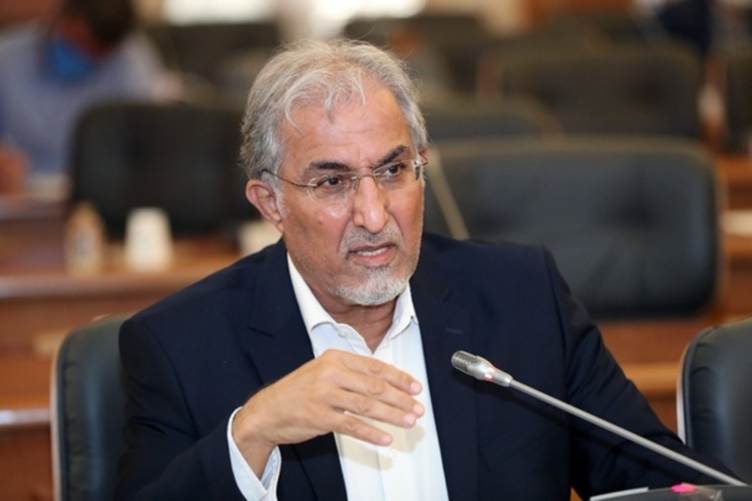
Hossein Raghfar, well-respected Iranian economist: Widespread state corruption has destroyed the Iranian economy and forced millions into poverty!
Hossein Raghfar: “61 people received loans totalling 130 trillion tomans (1.3 billion US dollars) from Bank Ayandeh [Future Bank] without collateral and have not repaid them…
With Bank Ayandeh’s debts, we could have built 120 speciality hospitals in the country! The Judiciary must state who it is going to hold accountable regarding the Bank Ayandeh scandal.”
Many Iranian economic experts, including Mr. Raghfar, attribute the root cause of Bank Ayandeh’s financial chaos to endemic corruption encompassing the intervention of powerful institutions in Iran’s economy, including the furnishing of massive unrecoverable loans to specific individuals or entities (such as the ‘Iran Mall’ project, which has been widely reported on elsewhere).
Mr. Raghfar’s statements emphasise the sheer scale of the corruption, severe imbalance, and major financial misconduct within Bank Ayandeh – which, according to him, has dealt a potentially fatal blow to the country’s economy and banking system remaining afloat.
In a report published by ILNA (Iranian Labour News Agency), Mr. Raghfar stated: “Regarding Bank Ayandeh, I must say that this bank has 450 trillion tomans in losses and 300 trillion Tomans in debt to [Iran’s] Central Bank.
“Furthermore, it provided 130 trillion tomans in loans to 61 individuals without collateral, and this amount has not been recovered. Under these very circumstances, the bank’s CEO has openly ridiculed and mocked public opinion by stating that the country’s economy should be in the hands of rational individuals, not corrupt ones!”
The economic expert and pundit went on to describe the factors between the merger of Bank Ayandeh with Bank Melli (National Bank) and subsequent dissolution and specifically referenced the disastrous impact of five other underperforming and non-regulation-compliant banks in Iran, all of which have been named by Central Bank, on money creation, liquidity, and inflation in the country.
“It must be noted that these Bank Ayandeh debts are reportedly 25 times the cost of building the Persian Gulf Star Refinery. With this money, we could have constructed 120 Super speciality hospitals in the country, or we could have created a rail network across the entire route of Tehran-Mashhad-Shiraz-Isfahan-Tabriz. These were the minimum infrastructure projects we could have built with this amount of money.
“Today, our question is where the government’s supervisory body was during this period, where it is now, and why the action to dissolve Bank Ayandeh was taken with such a delay. I heard that they have cited the lack of a necessary legal provision [to take action] as a pretext for the delay in dissolution, but this justification is irrelevant and untrue.”
Mr. Raghfar emphasised: “The important issue is that the backing for these banks and these individuals are institutions of power, and funds are provided to these powerful institutions in the form of loans that are never repaid. This is why the banks face enormous deficits.
“Why are the major bank debtors not brought to account before the people and the judiciary? It is because these individuals hold power, and neither the judiciary can prosecute them, nor can the parliament enter into this matter. Therefore, as long as these conditions persist, we have no solution for the country’s economic problems and difficulties.”
Regarding the imbalance (“natarazi”) of another state-owned Bank Sepah in serious trouble, Mr. Raghfar remarked: “Bank Sepah was not non-compliant before its merger with five military and law enforcement banks/institutions. After the merger, vast resources of corruption, accumulated losses, and enormous debts entered Bank Sepah’s accounts, and it was clear that Bank Sepah would become non-compliant. The claim that Bank Sepah was non-compliant before this merger is a big lie; rather, the merger caused this imbalance.
“The bank that transferred the greatest imbalance to Bank Sepah was Ghavamin Bank, which was suffering the largest deficit and loss. In a mistaken decision, they transferred unrecovered funds to Bank Sepah. After that, they took people’s small deposits and entered into whatever activities they desired. Now, the people must pay the price for the resulting losses.
“The consequence of this massive debt is that the economy has become so fragile that we are now facing these interconnected crises. Moreover, there is a possibility that Bank Melli could also become one of the non-compliant banks in the future.”
Mr. Raghfar emphasised that, “The Judiciary must state who it is going to hold to account regarding Bank Ayandeh. I believe that as long as the ‘spiral growth of corruption’ exists in the economic system, we will not have a solution for improving the economy, and by preserving these infectious centres of corruption, we cannot effectively fight against it. To eradicate corruption, governing institutions must exit the economy [state bodies must be removed from the finance system].”