



 Posted in
The United States and Iran are escalating their tit-for-tat strikes, posing the biggest threat yet to their framework deal.
Elizabeth HagedornJul 9, 2026
WASHINGTON — A short-lived ceasefire between the United States and Iran is giving way to spiralling violence, barely three weeks after the two sides reached a memorandum of understanding that President Donald Trump has since declared is “over.”
“I’m not sure I want to make a deal with them,” Trump told reporters Wednesday on the sidelines of the NATO summit in Ankara, adding that Iran’s leaders were “scum” and he might reimpose a naval blockade on Iranian ports.
That the truce is unravelling so soon after its June 17 signing is unsurprising, experts say. In rushing to secure an exit from the war, negotiators produced a vaguely worded 14-point memorandum of understanding that didn’t resolve the two countries’ core disputes.
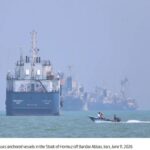
The Strait of Hormuz has emerged as the biggest spoiler. Paragraph five of the memorandum called for Iran to arrange for the “safe passage” of commercial vessels toll-free for 60 days, before working with Oman and other Gulf states to determine the strait’s future administration.
The two sides have fundamentally different readings of that section. The United States believes traffic in the Strait of Hormuz should revert to the pre-war status quo in which ships can move freely, but the memorandum’s ambiguity has let Iran argue it can control traffic, said Gregory Brew, a senior analyst at the Eurasia Group.
Iran is reluctant to surrender its leverage over the critical energy route, which handled 20% of the world’s oil supplies before the war. Since the deal was reached, Iran has targeted oil and gas tankers that aren’t following its pre-approved shipping lanes and are instead using a US Navy-protected route along Oman’s coast, according to the UK Maritime Trade Operations Center. In recent days, Iranian attacks have brought traffic on the Omani route to a near standstill.
“The Iranians have accomplished what they set out to accomplish,” Brew said, suggesting Tehran could therefore soon pause its maritime attacks. “It still leaves this overarching question as to whether Iran can continue to use force against shipping in the strait without triggering US escalation.”
Ceasefire in peril
The United States carried out a wave of strikes early Thursday that US Central Command said hit more than 90 targets, including Iranian air defence systems, military surveillance infrastructure, and missile and drone storage sites. Iranian state media reported that a strategic railway bridge in the country’s northwest was struck by US forces, potentially signalling a new phase in the conflict.
In retaliation for the second consecutive day of US strikes, Iran’s military and Islamic Revolutionary Guard Corps said they fired missiles and drones at military sites hosting American forces in Kuwait, Bahrain, Qatar and Jordan. Despite the fresh attacks, Brew said both sides are operating under the assumption that the other does not want to resume full-scale hostilities.
“The [memorandum] is really only two things: It was an agreement to end the war, and it was an agreement to reopen the strait,” said Brew. “Iran is now disputing the second part because I think it is fairly confident that the first part will hold.”
Trump has threatened to escalate beyond limited strikes, including by taking the Kharg Island oil export terminal and hitting Iran’s electric plants and other civilian infrastructure. But it’s unlikely that such use of force would change Iran’s calculus, said Alan Eyre, a former US diplomat involved in the negotiations on the 2015 nuclear deal.
“I don’t see a point at which the IRGC collective leadership in charge now — which is far more anti-US, far less trusting of the US, far more radicalized — is willing to bend the knee to President Trump,” said Eyre.
Diplomatic scramble
The mediators are meanwhile scrambling to preserve the ceasefire. Pakistan’s Foreign Office called on both sides to exercise restraint, saying in a statement Wednesday that “a renewed conflict is in no one’s interest.”
Iranian Foreign Minister Abbas Araghchi held separate phone calls Thursday with Pakistan’s Army Chief Asim Munir, Qatari Prime Minister Sheikh Mohammed bin Abdulrahman Al Thani, and the foreign ministers of Saudi Arabia, Oman and Turkey.
On his way back to Washington late Wednesday, Trump told reporters traveling with him on Air Force One that Iran had also called him to voice interest in a deal.
“They want to make a deal so badly,” Trump said. “I don’t know that they’re going to honor the deal.”
Neither side has confirmed plans for a third round of talks, and even if one is scheduled, it’s unclear how productive it would be. Slowing progress on a deal, Tehran refused to meet directly with the US negotiating team during the last round of talks in Doha.
Recalling the lead-up to talks that produced the 2015 nuclear deal, Eyre pointed to a moment when both US and Iranian officials “rolled up their sleeves and said, ‘We want to negotiate a solution.’” That, he added, hasn’t happened in earnest this time.
Absent such diplomacy, Eyre predicts a continued cycle of “neither war nor peace.”
AL-MONITOR