




 Posted in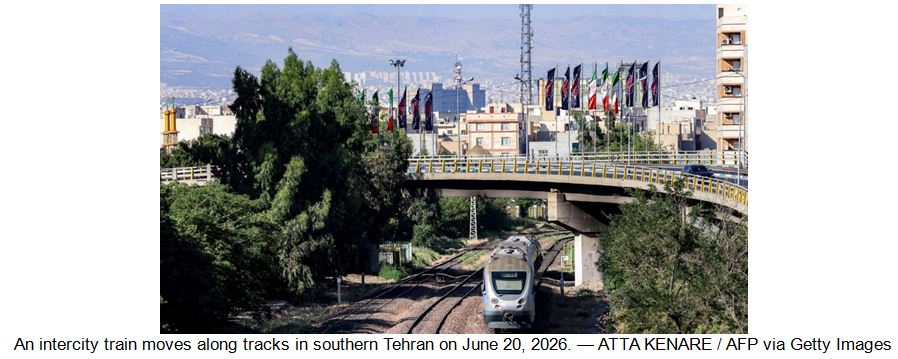
The railway bridge also links Tehran and other southern cities to Mashhad, where large crowds are gathering for the burial ceremony on Thursday of Ayatollah Ali Khamenei.
Jack Dutton
Jul 9, 2026
The United States struck Iran’s Aq Taqeh Khan railway bridge, a strategic trade link to China, Kazakhstan, Turkmenistan and Russia, in a missile attackThursday morning, the Islamic Republic’s semiofficially Fars News Agency reported.
The cruise missile attack hit the bridge in the northeastern Golestan province, the agency added.
Iran’s Islamic Revolutionary Guard Corps said it was a US missile strike, according to Fars. No casualties have been reported, but passenger and freight traffic on the line has been disrupted while engineers assess and repair the damage.
The disruption affected services from the capital, Tehran, and other southern cities to Mashhad, where large crowds were gathering for the long-delayed burial ceremony on Thursday for Supreme Leader Ayatollah Ali Khamenei, who was killed in the first US-Israeli strikes on Iran in late February.
Iran’s state railway told Fars that repair crews were sent to the site and the stranded passengers would be transported by road to Mashhad.
The strike came as the United States and Iran exchanged attacks for a second consecutive day following the collapse of their interim peace agreement. The United States also struck other Iranian infrastructure overnight, while Iran said it struck US assets in Bahrain and Kuwait in response. Later on Thursday, Iran launched additional attacks on sites in Jordan, Kuwait and Iraq, state media reported.
Why it matters: The Aq Taqeh Khan railway bridge forms part of the Agh Qala-Incheh Borun railway line, which transports cargo and passengers in Iran and connects to a broader railway network that links Iran to China and Central Asia. The China-Iran railway corridor specifically stretches over 10,400 kilometres (6,462 miles) from the Chinese cities of Xi’an and Yiwu to Tehran’s Aprin Dry Port in Greater Tehran, passing through Kazakhstan, Kyrgyzstan, Uzbekistan and Turkmenistan.
The railway route has also been used by Russia for cargo shipments to Iran since late 2025, according to the Fars report.
Although there are no publicly reported throughput statistics for the bridge itself, China is Iran’s biggest trading partner, and the annual transit capacity of the China-Iran railway corridor is estimated at more than 1 million tons of cargo, with up to five departures per week, according to a Tehran Times report from May. Although most trade between Beijing and Tehran still moves by sea, land-based trade has been gaining importance, particularly as the war has disrupted shipping through the Strait of Hormuz.
A January report by Iran’s West Asia News Agency (WANA) said 43 freight trains from China had entered Iran over the past nine months — a nearly sixfold increase compared to previous years. These trains primarily transport solar panels, power plant equipment and industrial parts, the report said.
The missile attack on one of Iran’s key rail links came on the second straight day of renewed strikes following the breakdown of an interim peace deal with the United States. It is also symbolic because it threatens to disrupt Khamenei’s funeral. The Iranian military had warned the United States and Israel against such an attack.
“We warn the enemies of Iran, especially the US and the Zionist regime [Israel], to avoid any miscalculation and to think about the harsh retaliation our armed forces would make to any threat and aggression against our country,” Ali Abdollahi, commander of Khatam al-Anbiya Central Headquarters, said in a statement carried by state media on July 2.
Know more: On June 17, Iran and the United States signed a Pakistan-brokered memorandum of understanding to end the war that began on Feb. 28 and take steps to curtail Tehran’s nuclear enrichment capabilities. The memorandum set a 60-day timeframe to negotiate a lasting deal to end the hostilities, though the talks had made little progress. Under the deal, ships were meant to be allowed to pass through the Strait of Hormuz near Iran’s coast safely. However, after three vessels were attacked in the key waterway on Tuesday, the United States struck Iran and President Donald Trump said the agreement was “over.”
AL-MONITOR