

 Posted in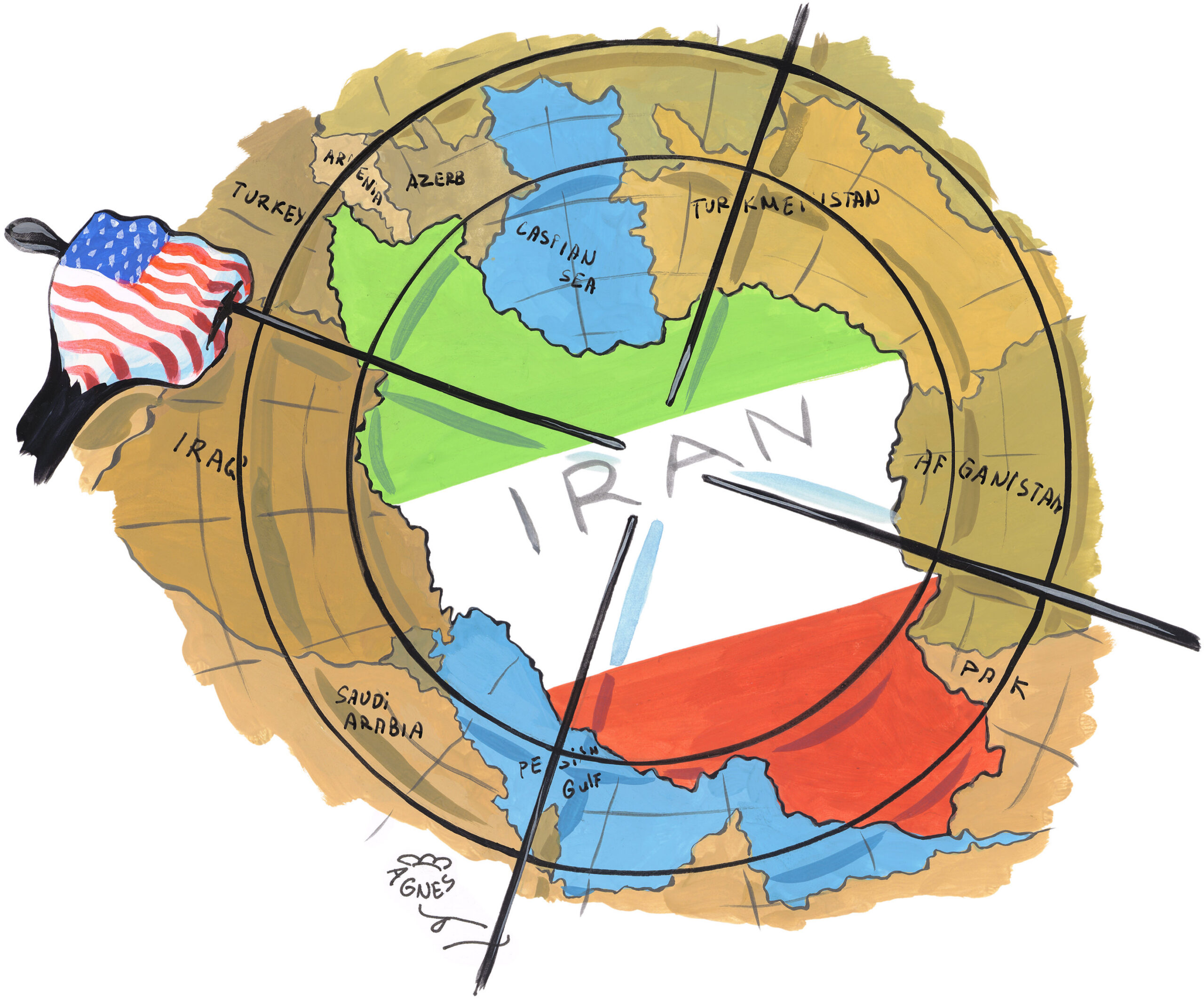
The US aim to reshape the existing order in the Middle East needs to be resolutely resisted, argues PAYAM SOLHTALAB
FOR decades, US imperialism and the fascist Israeli regime have sought to establish a new order in west Asia. Twenty years ago, on July 21 2006, amid the Lebanon War, then US secretary of state Condoleezza Rice stated: “What we are seeing here is the growth — the birth pangs of a new Middle East.”
Today, the drive to establish a “new order” in west Asia has gained renewed traction and significant momentum through the “Trump-Netanyahu” axis.
Over the past 14 months, Iran has been the target of two brutal joint military attacks by the US and Israel — the first on June 13 2025, a war that lasted 12 days; the second on February 28 2026 for approximately 40 days thereafter in the fiercest barrage of the currently ongoing war.
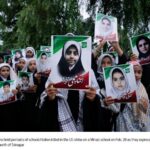
On the very first day of this aggression, 156 people were killed in a school in Minab by Tomahawk cruise missile strikes, including 120 primary school children, their teachers and parents, among others.
According to official Iranian figures, more than 3,500 Iranians were killed during the 40-day bombardment alone. Both attacks began while Iran sat at the negotiating table discussing its nuclear programme.
Over 100,000 homes were destroyed, and key industrial complexes such as steel, oil and refining facilities and manufacturing plants were targeted. In addition, hospitals, the pharmaceutical industry, universities, bridges, water treatment plants, and numerous historical monuments across the country were bombed.
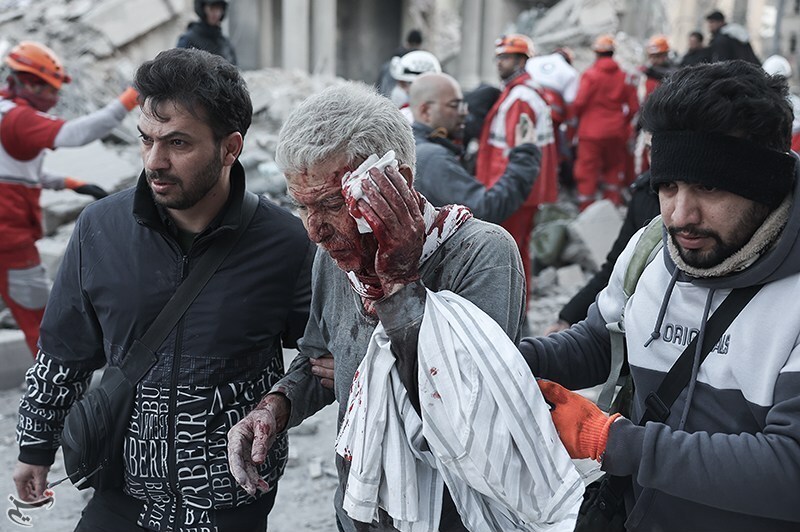
Iran has estimated the war damage at approximately £200 billion.
On June 17, following mediation by Pakistan, a framework peace agreement — the Memorandum of Understanding — between Iran and the US to end the war was signed electronically. However, the agreement did not last long due to a resumption of US military attacks.
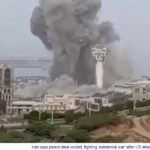
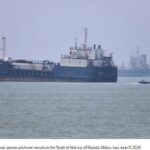
From July 7, Iran became the target of US aggression for the third time when for 17 nights the southern regions along the Persian Gulf were hit with missiles and drones.
It needs to be underlined that the joint air raids by the US and Israel on Iran were in clear violation of international law, a point on which there is consensus among most international law experts.
Objectives of the military aggression against Iran
The attack on Iran should be seen as a step in the ongoing effort to establish the above-mentioned “New Order” in the Middle East region with an accompanying new power structure.
The attack was certainly not intended to liberate the people of Iran from the yoke of the current dictatorship, even though attempts were made to portray it as a “moral act.”
Rather, it was an attempt to destroy Iran as a regional power and replace the current clerical regime with a dependent, authoritarian puppet government.
In addition to the scenario of regime change, there were also other plans — such as instigating a civil war, undermining the country’s territorial integrity, or even bringing about the dismemberment and “Balkanisation” of the country.
Trump has made repeated apocalyptic threats towards Iran, announcing that he would bring about the death of Iran’s “whole civilisation […] never to be brought back again” as well as “bring them back to the stone ages, where they belong.”
The warmongers in Washington and their allies in the Israeli government have opposed any agreement between Iran and the US and are seeking a gruelling war of attrition with Iran, aimed at destroying Iran’s critical civilian infrastructure and its ability to function as a nation state.
US Vice-President JD Vance claimed in an interview with the Joe Rogan Express podcast on July 15, that a “covert and very costly” campaign had been launched to sabotage negotiations. This campaign is being organised by “Israeli actors” whose goal is to continue the war with Iran “indefinitely.”
The future of the war against Iran remains uncertain. The current “neither war nor peace” situation remains extremely unstable, and there are legitimate fears that it could escalate into a full-scale, devastating war.
What is the situation inside Iran?
The dire economic situation inside Iran has acutely worsened as a result of the war. The bombing of Iran’s steel industry, oil and refinery facilities, and other production units has left two million people out of work against an already staggeringly high unemployment rate.
An Iranian Parliamentary Research Centre report estimates 41 per cent of the population is living below the poverty line in 2026.
Skyrocketing rents, food costs, shortages and high costs of medicines, the free fall of the currency, and unemployment paint a picture of precarious existence for millions of Iranian families.
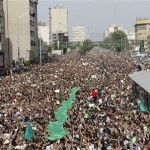
The uprising in January 2026, which in its early days was a peaceful protest against devastating neoliberal economic policies, poverty, and oppression, became increasingly violent, owing to US-Israeli interference and the clarion calls from Reza Pahlavi, the son of the former autocratic ruler deposed by the Islamic Revolution in 1979.
The theocratic regime’s ensuing brutal crackdown on the uprising from January 8 to 10 sparked a righteous wave of anger and revulsion throughout Iranian society. Even according to the regime’s own official figures, 3,170 people were killed in the space of just 48-72 hours.
The scale of the killings undoubtedly places this chapter among the worst in Iran’s recent history. Many thousands more have either been arrested or forcibly disappeared by the regime during this period, and Iran is witnessing a spike in executions at a level not seen since the dark days of the late 1980s.
The subsequent war on Iran provided the regime with a golden opportunity to obscure this crisis of legitimacy stemming from repression, the dire economic situation, and class divisions.
It is no coincidence that certain powerful forces in Iran — the “warmongers” — are attempting to resurrect the faded but destructive Khomeinist mantra of “War, war until victory” through exaggerated claims about Iran’s military prowess.
One of the devastating consequences of the war was the severe blow and major setback it dealt to the popular and progressive movement inside Iran seeking a national democratic transition — a movement that was gathering steam and gaining traction within society up to that point.
What Is to Be Done?
Major threats continue to loom over Iran’s future, national sovereignty, and territorial integrity. The Iranian people desire peace so they can shape their country’s future without external pressure or interference. It is only with peace that civil society can flourish.
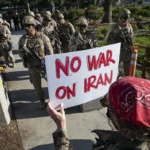
Mobilising global public opinion to end the crimes of the US and Israel against Iran is a crucial task facing progressive forces both inside Iran and abroad.
Furthermore, it is an urgent task for Iran’s progressive and democratic forces to give voice to the demands of a society exhausted by poverty and oppression, and to lay the groundwork for a nationwide movement against war and warmongers.
Experience has shown that whenever the external threat subsides, domestic political, economic, and social issues once again take centre stage. Among these, demands for an end to neoliberal economic policies and the immediate release of political prisoners are of utmost importance.
The resurgence of protests by workers, pensioners, teachers, nurses, students, and women represents one of the greatest challenges for the Iranian regime going forward.
Defending world peace and combating war and warmongering are central to the anti-imperialist struggle being waged today for a world built on solidarity. This can only be achieved through a joint effort and a comprehensive mobilisation of the public on a global scale.
Peace is not an all-encompassing guarantor — though without peace, there is no foundation on which to build anything else.
This article is prepared by Payam Solhtalab, an active member of the Central Council of CODIR.
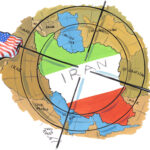
The source of the main image: Creator: Agnes Avagyan Karikaturen | Credit: www.Live-Karikaturen.ch, CC BY-SA 4.0